When Charles Hamilton created Painshill, he was famously inspired by his Grand Tours across Europe. On his travels, he absorbed the history and mythology of ancient cultures and sought to recreate elements of this in England. Painshill’s follies and features reflect Hamilton’s fascination with the classical world, but there was one mythical figure that Hamilton grew particularly fond of.
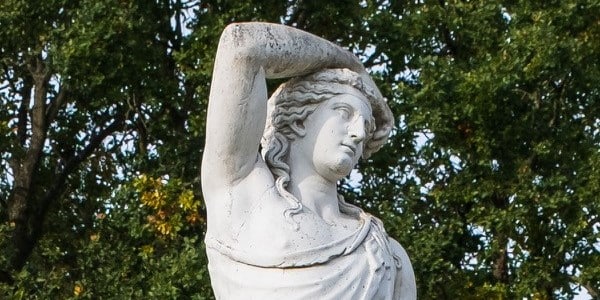
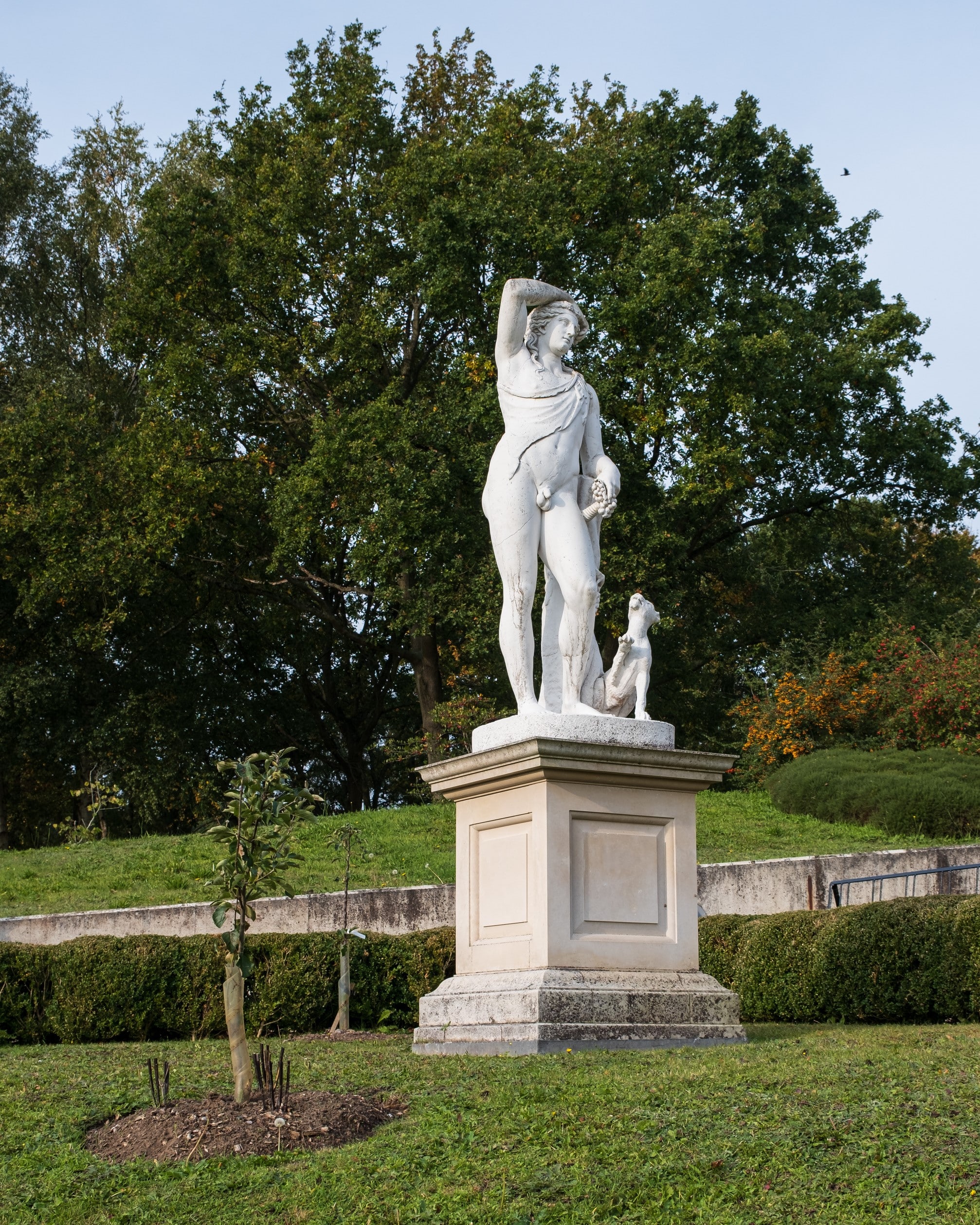
Just beyond the Walled Garden, Painshill’s visitors are greeted by a large statue of a Roman god. He stands proudly, with one hand angled behind his head and the other clasping grapes. Apart from the scrap of fabric draped over his chest, he is completely nude. This is Bacchus, the God of Wine – a rather apt protector for Painshill and its beautiful vineyard. However, Bacchus has a secret: he is a ‘patchwork’ statue, and a very expensive one too…
The Statue of Bacchus at Painshill.
A Very Expensive Statue
The statue was allegedly acquired by Hamilton in 1727 during a trip to Rome. Hamilton claimed to have purchased it from an aristocratic family for a hefty £2,000, which would equate to approximately £366,000 today. This was an extortionate amount of money for a statue that was a patchwork of multiple broken marbles stuck together. Hamilton’s Bacchus has the head of a Roman goddess placed onto a masculine body. The head and feet are certainly the oldest parts of the statue, and the only pieces that can confidently be called ‘ancient’. Even these, however, have likely been adapted. The sculptor who created this ‘Frankenstein-style’ piece likely made minor adjustments to masculinise the face. He would have thinned the lips and added stone to broaden the cheeks.
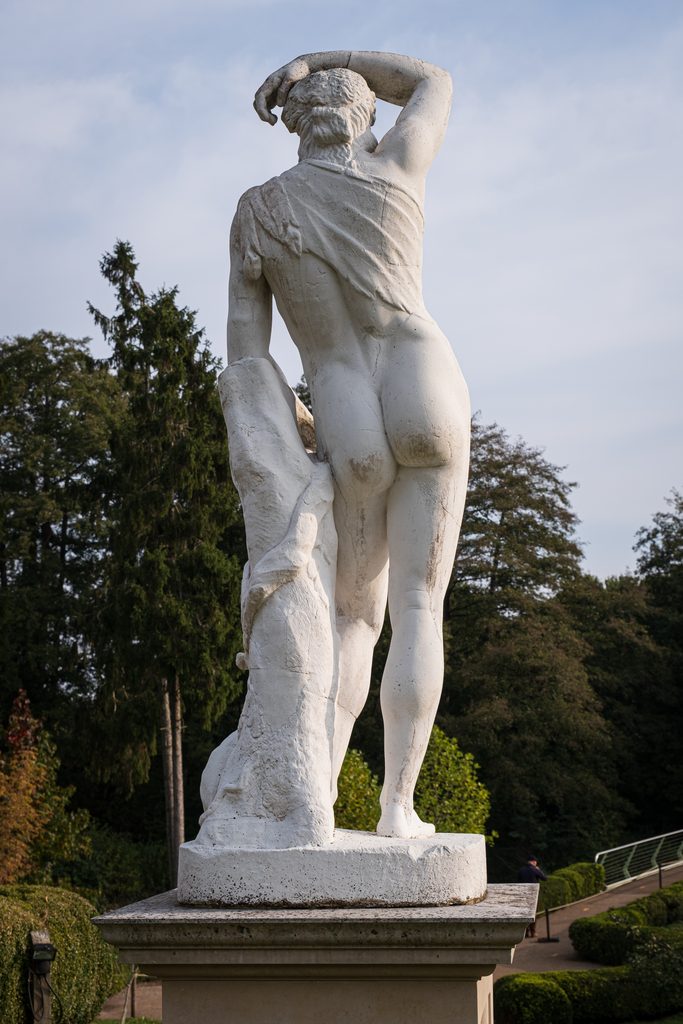
The torso was likely also the work of an 18th century sculptor. So is the doglike creature standing at the base. The feet of this animal suggest that it would’ve originally been a panther – Bacchus’ mythological companion – but the shrewd sculptor may have added doglike parts to appeal to English clientele. Dogs were popular companions in 18th century English portraits. In fact, in Hamilton’s 1732 portrait, he too is painted with dogs at his feet.
A Home for Bacchus
Whether or not Hamilton realised the true nature of what he had bought, he was happy with his wine god and built a temple to house him at Painshill. Bacchus lived in his temple until 1797, when he was sold at auction for £400 to an incredibly wealthy young man named William Beckford (Hamilton’s great-nephew). Beckford displayed the statue in the dining room of Fonthill Splendens. However, Beckford’s contemporaries had become aware that the statue comprised a patchwork of marble fragments. They wrote that they wouldn’t have paid half so much for it.
The back of the Bacchus Statue
The statue continued to depreciate.
Bacchus was sold a third time to a Mr Abbott in 1807; the price having reduced to 210 Guineas. Abbott was acquiring the piece on behalf of Thomas Johnes. Johnes (like Hamilton) had created his own landscape garden – the Hafod Estate in Wales. When the Hafod Estate was purchased by the Duke of Newcastle in 1832, Bacchus was eventually sent to London to be auctioned by Christie’s. The statue continued to change hands throughout the following century, and when he was sold again in 1928, it was for a disappointing £13. This is a far cry from his alleged original price.
Bacchus was purchased a year later by the 1st Baron Fairhaven. This final sale restored some of his value and saw him moved to Anglesey Abbey in Cambridgeshire, where he still lives today. In 2008, a cast copy was made for Painshill, which is proudly displayed by the Visitor Hub. Today, Bacchus embodies the vision and spirit with which Hamilton created Painshill: he brings a small pocket of classical beauty to the English countryside.
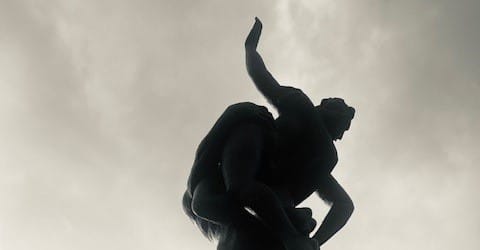
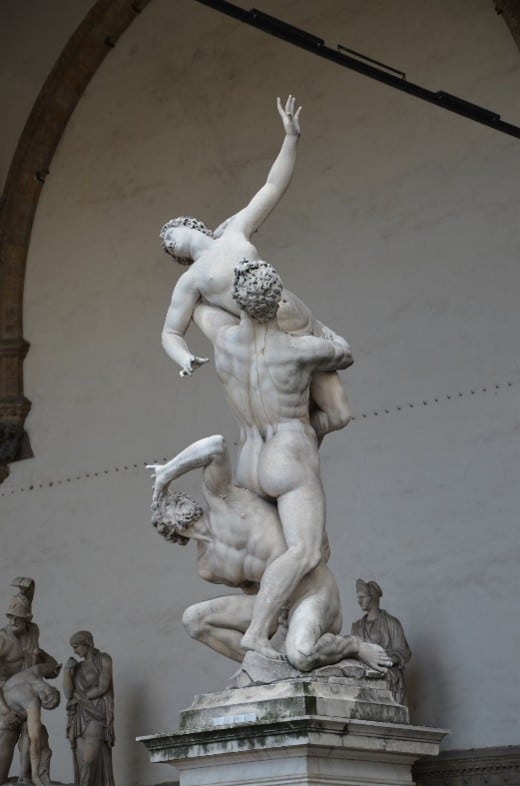
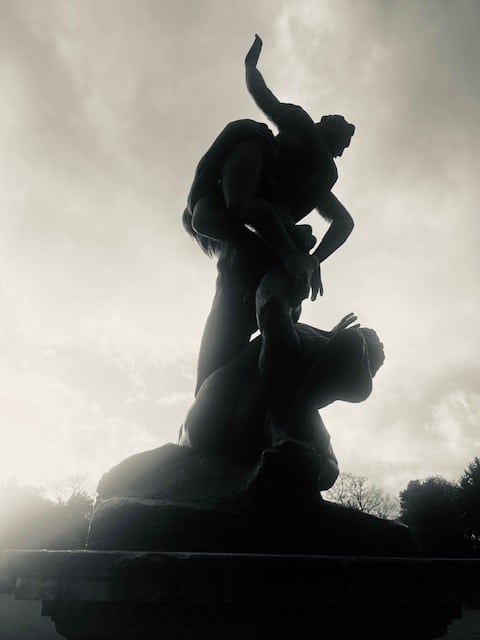
As the sun sets, light spills over a statue on the eastern boundary of Painshill’s Great Lawn. Shadows are cast over a tangle of bodies; three figures performing an ancient Roman myth. The figure at the base is a bearded older man crouching on the plinth. He throws one hand above his head in fear as a younger man overpowers him. A terrified young woman struggles in the arms of her muscled kidnapper. She represents the Sabine women; the young man is her Roman captor; the older man is her father. This scene portrays the foundation myth of Rome: The Abduction of the Sabine Women.
Giambologna’s Abduction of a Sabine Woman (1582). Housed in the Loggia dei Lanzi in Florence, Italy.
Hamilton’s statue was based on an original by Flemish sculptor Giambologna in Florence, around 1582. It is a masterpiece of 16th century mannerism – a style that adapted the symmetry and perfection of Renaissance techniques to create twisting, serpentine figures. The original model is currently housed in the Loggia dei Lanzi in Florence. Due to the popularity of the piece, casts were sold to buyers like Charles Hamilton in the early 1700s. John van Nost created a lead cast around 1710, and after he died, his workshop was purchased by John Cheere, who continued to manufacture these lead casts. Hamilton likely visited Cheere’s workshop to select and purchase the piece. He paid £25 for the Sabine Statue in 1763, which is a noticeable drop from the £90 Nost was quoting in the early 1700s. The price Hamilton paid is equivalent to approximately £4,400 today.
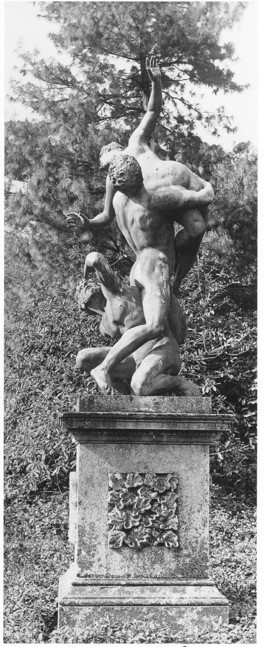
Painshill’s original Sabine statue photographed in 1904.
The Myth
According to the Ancient Romans, their city was founded by the mighty demigod Romulus. Romulus and his twin brother, Remus, were sons of the war god Mars and a Vestal Virgin named Rhea Silvia. As babies, the twin boys suckled the milk of a she-wolf and were raised by foster parents. As men, they raised an army and established the foundations of a city. However, the power balance between the brothers became uneasy. This unease grew into anger and mistrust, and eventually Romulus killed his brother, assuming sole control over his new civilisation: Rome.
However, Romulus’s problems were far from over. He had a city of soldiers; a city of only men. Without women, he knew that the civilisation he was building would die out within a generation, and so he led his men to abduct the local Sabine women. This incited a bloody conflict between the Romans and the Sabines, ending only when the women threw themselves between their Sabine fathers and their Roman husbands to stop the violence. This is the emotionally charged tale that the statue depicts.
Painshill’s Sabine statue at sunset (February, 2026)
The Mystery
The history of Hamilton’s Sabine statue becomes shrouded during the Second World War. When Painshill was requisitioned for use by the Canadian Army, Painshill’s follies were badly neglected. In fact, there were several rumours as to the fate of this magnificent statue. Some believe that it was used for target practice by the Canadian Army when they carried out training on the Great Lawn. In all likelihood, the piece was melted down and sold for lead in the early 1950s. A gentleman named Mr Waller, who started working at Painshill in 1941, remembered the statue well. In 1985, he recalled how it had been badly damaged in the winter of 1951/1952. Tragically, an arm of one of the figures had been hacked off. The owner of Painshill’s woodlands, Captain Mould, sold the statue to a merchant. There isn’t a record of who he was, but it seems that the merchant was interested in the piece for its lead content, rather than its historical value.
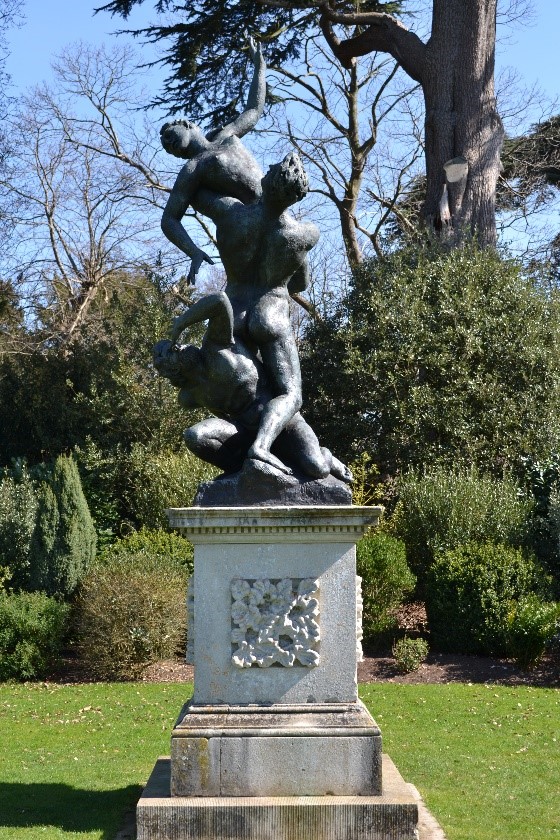
In the 1990s, efforts were made by talented sculptor Ivor Abrahams to recreate the piece for Painshill. He travelled to Florence, observing, photographing and sketching the statue in great detail. Back in England, he worked tirelessly to bring his creation to life. First creating a plaster sculpture, and eventually a bronze one that has stood on the original Portland stone foundation since 1993. The piece is not a replica (it stands at 2.6 m high compared to Giambologna’s 4.4 m) but rather an homage to the original; capturing the essence of its style, theme, and vision, and restoring the classical beauty to the Great Lawn.
Ivor Abrams Sabine statue stands on the original stone plinth on Painshill’s Great Lawn.
The Sabine statue tells a story of talent, myth, and mystery. It is an ode to the ancient world and the fortitude taken to bring Painshill back to life.
Long may it stand on its plinth, sharing the secrets of its past.
Romance, rockeries, and a ruined temple…Meet the last lady of Painshill.
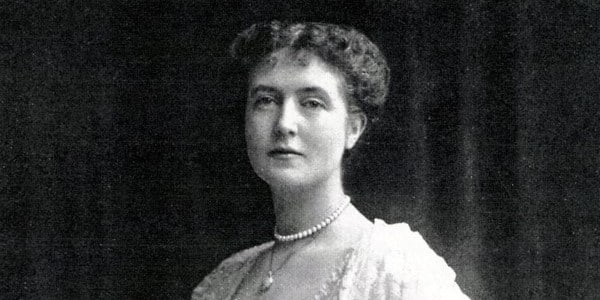
Painshill has countless mysteries hidden within the follies and the underexplored nooks of the landscape. However, the people who have lived and loved here also carry a myriad of secrets. Painshill’s most famous owner is, of course, its founder Charles Hamilton. But a vivacious woman named Ethel Combe was arguably the most complex. Ethel lived at Painshill for fifty years and oversaw its final chapter before it fell to ruin in the postwar era. Ethel was glamorous and wilful, leaving a lasting impression on the landscape and the wider Cobham community. In some ways, she was a controversial figure. Her adaptations at Painshill resulted in the ruin of two follies. Her romances were unconventional with significant age gaps, and, at times, she found herself a subject of gossip. However, as we shall see, the phrases engraved on the headstones of Ethel and her husband Charles reveal a shared sentiment: that immortality exists in remembrance. So perhaps Ethel would quite like to be remembered for her complexity and impact – these are, after all, the qualities that make her such an interesting figure. Up until now, very little has been written about Ethel, but with evidence gathered from the letters of poet Mathew Arnold, census records, marriage records, and indeed her own headstone, we can finally piece together an image of a charismatic and determined character.
EARLY LIFE AND FIRST MARRIAGE
Alice Ethel Leonard (as she was known then) was born on the 7th of September 1863 to John William Leonard and Fanny Warren. Her father was a merchant in the East India Trading Company. Birth records show that she was born in Norwood, Lambeth, and on later records, she seems to pinpoint the spot to Gipsy Hill. This area derived its name from the large gypsy community that had long been established there. At the time of Ethel’s birth in the mid-19th century, Norwood was undergoing a massive transformation into a suburban community that was expedited by the development of the railway and the iconic Crystal Palace.
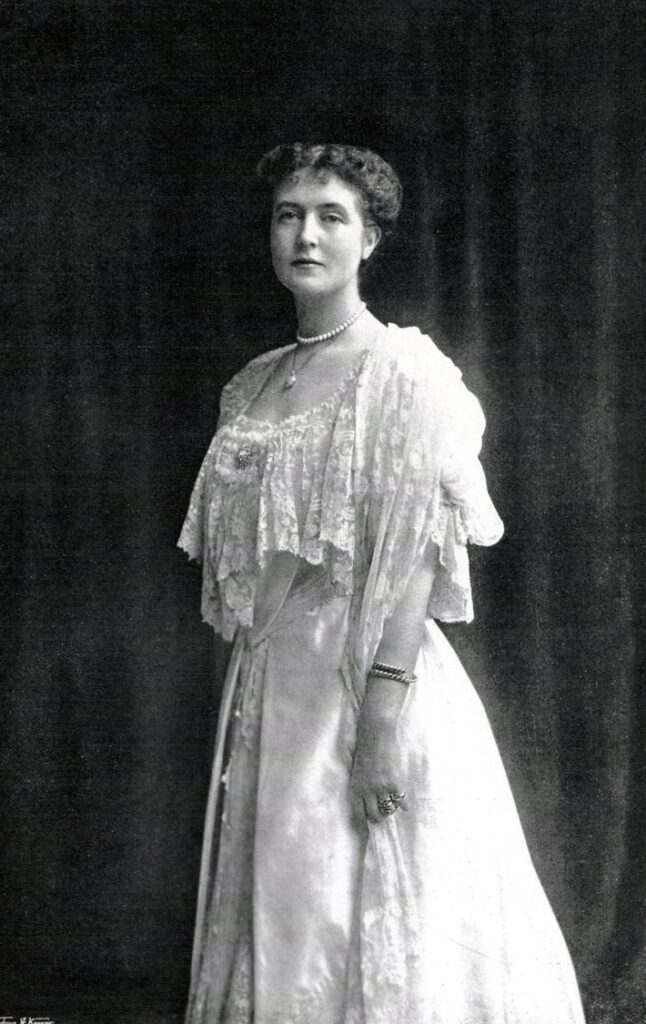
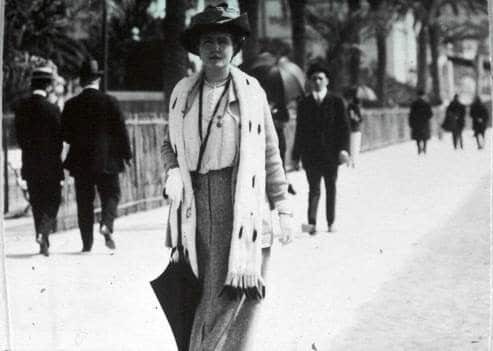
Alice Ethel Combe (1863-1942).
Although based in London, she seemed to have solidified herself as a vibrant character on Cobham’s social scene by age 24. As a gorgeous, young, unmarried woman, she was the talk of the village and featured several times in poet Matthew Arnold’s letters to his daughter. Whilst staying in Painshill Cottage, he wrote that everyone in the community agreed that Ethel was stunningly beautiful and commented that “she seems well disposed to enjoy it herself while it lasts.”
It seems that Ethel often found herself at the receiving end of equivocal remarks. She was undoubtedly an attractive and friendly young woman who easily appealed to the opposite sex. Matthew Arnold commented, rather harshly, in December 1887 that he did not think she dressed nor held herself particularly well and yet men still flocked to her. He also noted that Percy Combe danced with her the entire evening, a gentleman who was the son of Charles Combe (Ethel’s future husband). The attention Ethel drew seems to have been sadly accompanied by judgement from the restrained Victorian society of her youth.
Ethel and her family had been staying at Painshill in the winter of 1887 as guests of the new owner, Alexander Cushney. Alexander was a merchant in Shanghai, suggesting that a friendship had been formed between himself and Ethel’s father based on their mutual profession. Alexander and Ethel were an unlikely pair. He was forty years her senior and when their engagement was announced in March 1888, it was met with “disgust and horror” according to Matthew Arnold, although he added that he personally supported the union.
Ethel and Alexander enjoyed a Spring wedding on the 25th of April in St. John’s Wood, Westminster. Her parents served as witnesses and the marriage record reveals that the couple were neighbours on Abbey Road at the time of the wedding. It seems that aside from Painshill, Alexander enjoyed a London residence. Records reveal that Alexander was aged 65 and widowed, having lost his first wife, Isabella Bisset in 1885. Ethel was only 24, making her a similar age to Alexander’s sons. We cannot know for certain whether they married for love or convenience, but as the years flitted by, Ethel once again found herself at the centre of village gossip.
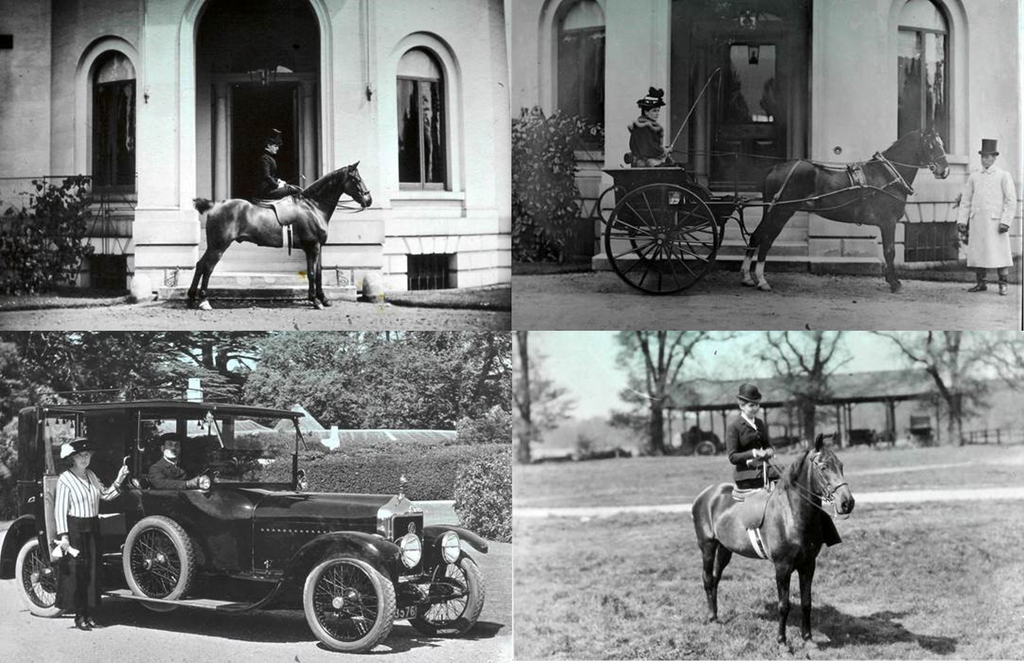
Ethel lived in an era of significant transportational change. In her youth, she would’ve travelled entirely by horses and carriages before swapping to cars in her later years.
MARRIAGE TO CHARLES COMBE
While at Painshill, the Cushneys were neighbours with the Combe family. In the late 19th century, Charles Combe was the head of this influential family and owner of the Cobham Park Estate. Charles was worldly and fascinating – he had spent a large portion of his youth in France and had travelled the globe during an exciting stint in the army. In 1900, he lost his beloved wife Marianne to scarlet fever. For Charles, this loss seemed insurmountable and he regularly broke down in tears. Sometime after Marianne’s death, Charles began to develop a close friendship with Ethel. Much to the shock of the local community, he would visit her at Painshill while her husband was away. These visits became increasingly frequent and eventually Charles’s family felt compelled to make their disapproval known. Letters reveal that Charles’s daughter, Florence, explicitly told him that the visits with Ethel were causing upset and she pleaded with him to stay away from Painshill. Not only did Charles refuse, but he told his daughter outright that if she continued to disrespect Ethel, he would cast her out of the family home.
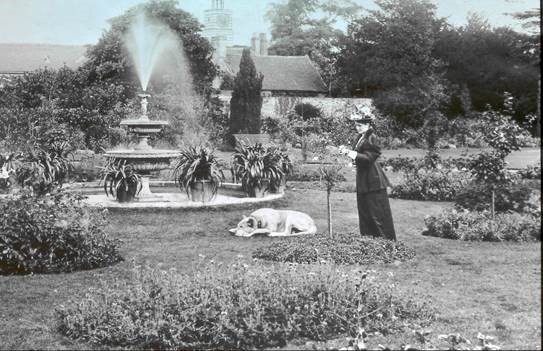
Ethel in the rose garden.
Whether Alexander Cushney knew that these visits were occurring and what he thought of them is difficult to say, but in July 1903 he passed away at Painshill, aged 80. Charles and Ethel waited three and a half years to marry after Alexander’s death. They wed at Marylebone Church on the 29th of December 1906. The marriage registry does not list their ages, but simply describes them as being of ‘full age’. Ethel would have been 43 and Charles 70 at the time of their marriage.
In the years since Alexander’s death, Ethel had desperately missed Painshill and urged Charles to buy the estate. He agreed and soon Ethel found herself living in Painshill House once again. In her time away, it appears Ethel had been planning – deciding how to modernise and adapt the landscape to her taste. Ethel had returned as Painshill’s mistress for the second time, older and with greater authority.
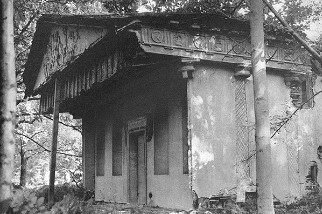
Ethel removed the columns and frieze from the Temple of Bacchus to build a classical loggia on the front of Painshill House.
ADAPTATION OF THE FOLLIES
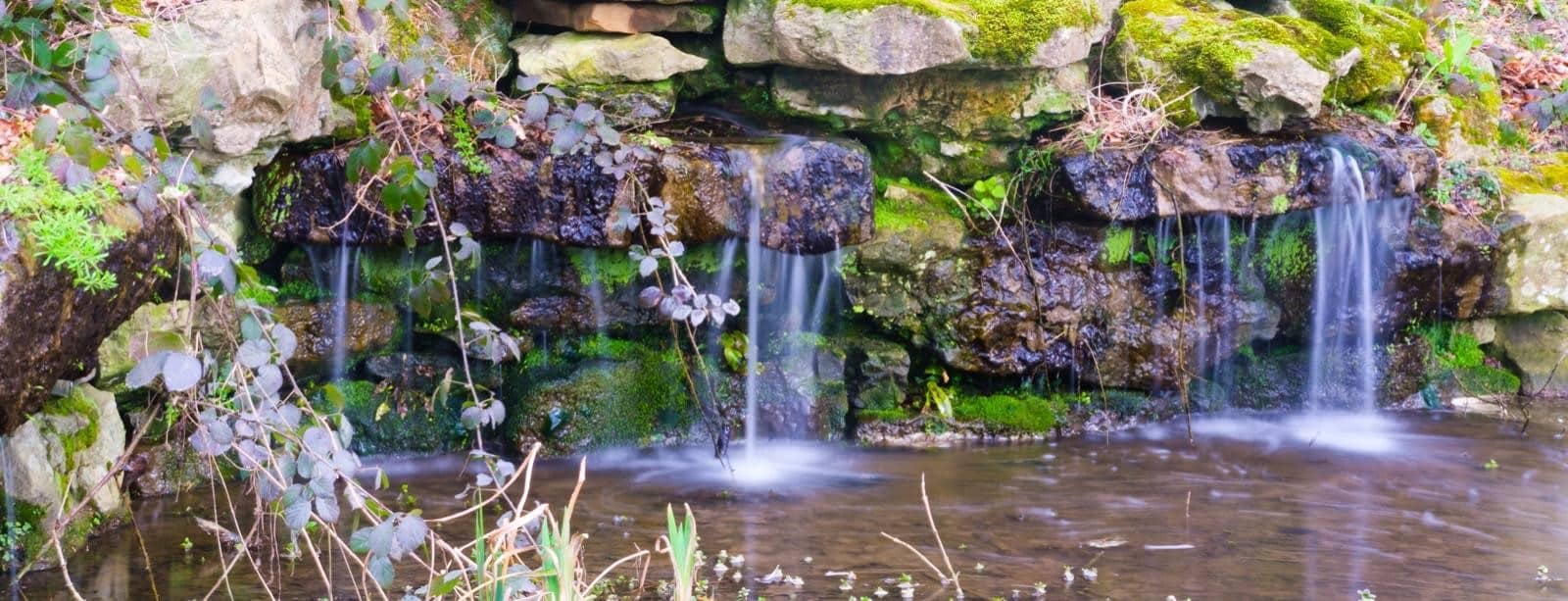
In 1907, Ethel took the rocks from Hamilton’s Cascade and used them to build her own rockery where the overgrown vineyard had been. The vineyard hadn’t been cared for in a century and so perhaps Ethel thought she was giving Painshill’s south-facing slope a new lease on life. Rockeries were incredibly popular in the Edwardian era and she repurposed the cascade rocks to create steps that led the visitor downwards through a garden of alpine plants.
Ethel’s changes at Painshill extended beyond the aesthetic. To adapt to the financial demands of the 20th century, she grew timber for sale as well as fresh fruit and vegetables in the Walled Gardens. This produce was sold at market, displaying innovation and financial savvy to overcome a tightening budget. Perhaps it was economic pressures that eventually led Ethel to make her most controversial decision at Painshill.
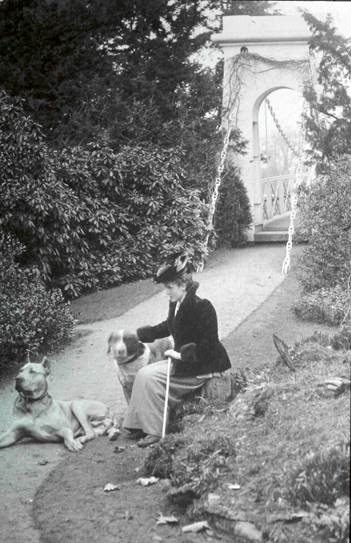
Ethel next to Painshill’s old suspension bridge.
When Charles Combe died in 1920, Ethel was widowed for the second and final time. On the census record, a year later, Ethel’s position had originally been listed as ‘widow’, but this was scratched out and replaced. ‘Head of the Household’ was the title most befitting Ethel Combe. In 1925, inspired by paintings of the original portico on Painshill House, Ethel created her own classical loggia at the front entrance. Instead of purchasing new materials to bring this vision to life, Ethel removed the columns and frieze from the Temple of Bacchus. The Temple, which had survived since the early 1760s was left in significant disrepair and eventually collapsed.
In hindsight, Ethel’s decisions were likely made as a result of the growing financial pressure on Britain’s upper class. The final, crushing blow arrived with the onset of World War II when Painshill was requisitioned for use by the Canadian Army. Ethel left her beloved Painshill and split her time between Munstead in Godalming, and Worthing, a coastal town in West Sussex. She died at Munstead on the 8th of October 1942, aged 79. Her effects were worth £81,253, which would equate to roughly £3.5 million today.
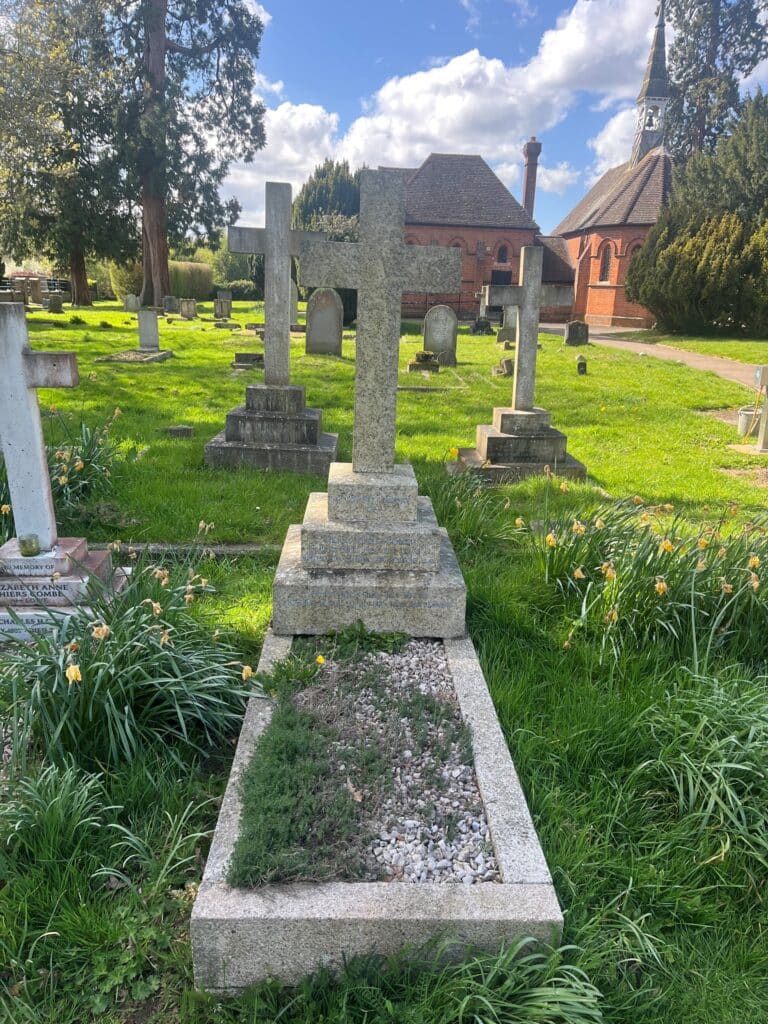
Ethel’s grave at Cobham Cemetery. It reads: In loving memory of Alice Ethel Combe who died Oct. 8th 1942. Widow of Charles Combe, J.P. Everything that has loved and has loved to the end will meet again.
Ethel’s obituary praised her legacy at Painshill and her work to support the local schools and village. She was buried in Cobham Cemetery. Engraved upon her headstone are the words ‘Everything that has loved and has loved to the end will meet again.’ Alone, this saying appears to be a beautiful sentiment about meeting loved ones in the afterlife. However, this phrase was the second half of a longer one by Giuseppe Mazzini, a revolutionary who fought for Italian unification. The first half of the saying can be found on Charles Combe’s grave: ‘There is no death in the world except forgetfulness.’ The two halves of this speech unite the couple in death and remind us that if we remember loved ones, their legacy never dies.
In telling their story – the good and the bad – we can give Ethel and Charles the immortality that they longed for. Ethel’s story has never before been told in its entirety. This has looked to give her a voice and offer an insight into the life and mind of a vibrant, strong, innovative, and complex figure.
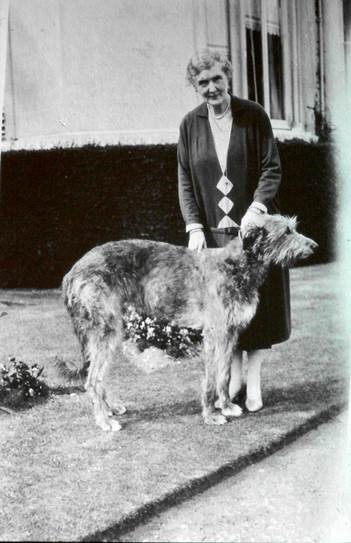
Ethel in her later years.
Ethel on holiday in Cannes.
Sources
Taylor, D. (2006). An Estate for All Seasons. Phillimore & Co.
Arnold, M. and Lang, C.Y. (2001). The Letters of Matthew Arnold: 1879-1884. University of Virginia Press.
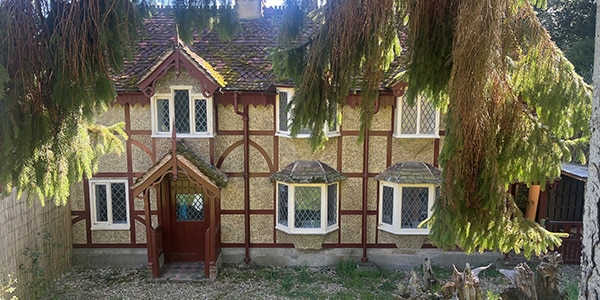
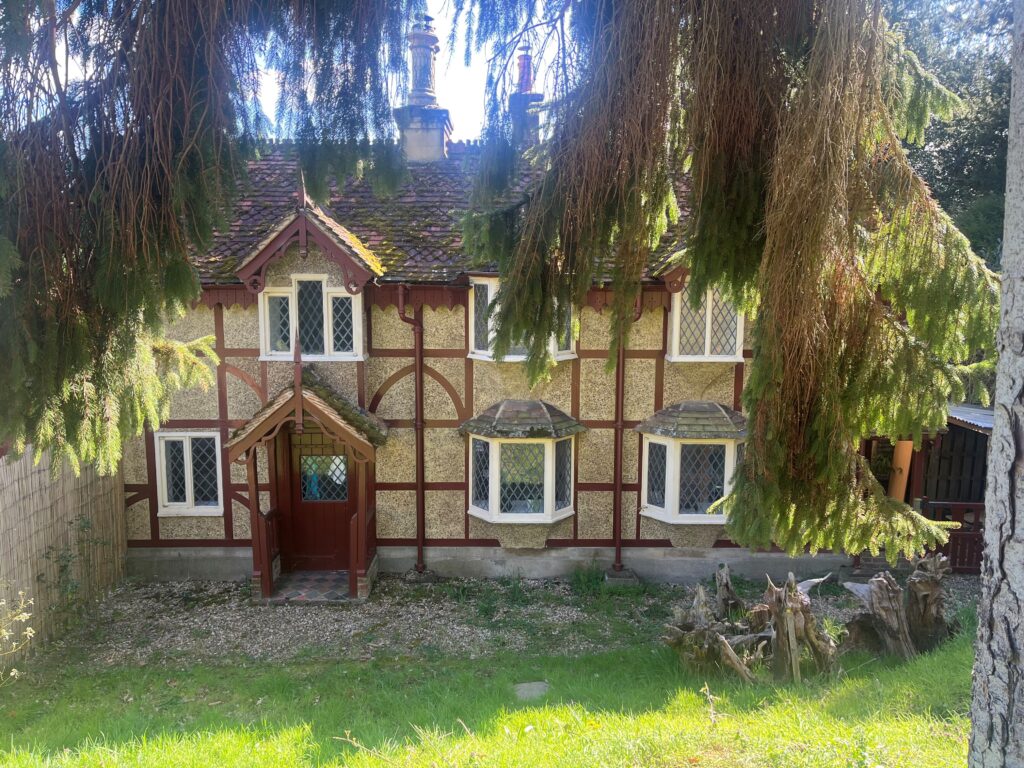
As you walk over the bridge into Painshill, the first thing you see is the Walled Gardens. It greets you with its high brick walls standing resolutely over the Mole River. You may have popped your head in once or twice, admiring the seasonal vegetables. Or perhaps you like to sit and read in the gentle tranquillity. As you stroll towards the Visitor Hub, you might notice an old cottage on your left. It’s two storeys high, with a steep sloping roof and decorative timber beams painted a deep reddish-brown. This is the Gardener’s Cottage. Today, it serves as a space for Painshill volunteers to relax between shifts, but its history is long, varied, and intertwined with the story of the Walled Gardens.
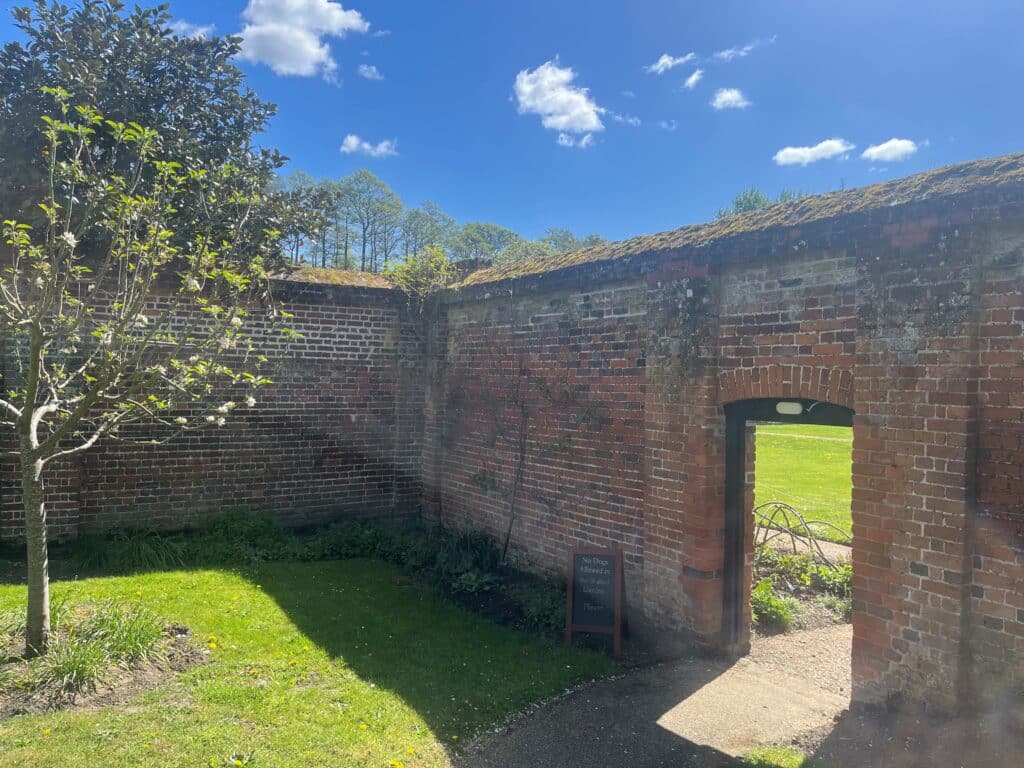
The entrance to the middle section of the Walled Gardens. Today, this section is used to host special events.
BEHIND THE WALLED GARDENS
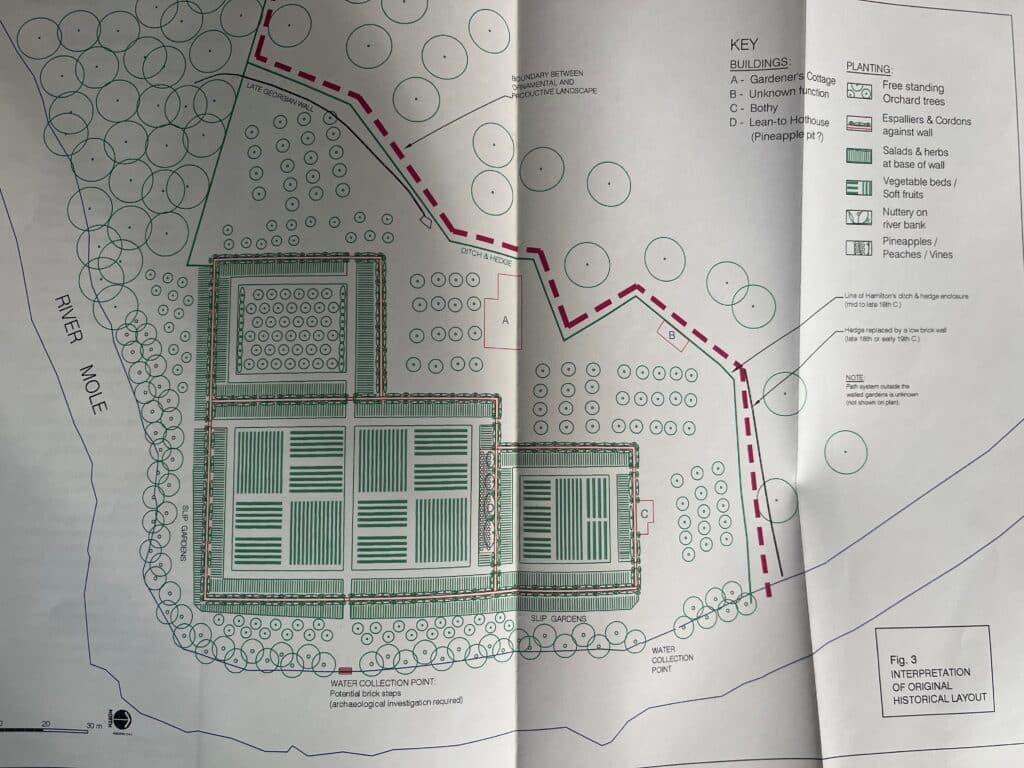
The Walled Gardens at Painshill consist of three conjoined sections. From an aerial view, they look like steps hugging the river’s edge. The section nearest the Visitor Hub is now home to the Kitchen Gardens. Anyone can visit this and see the colourful vegetables destined for the Tea Room. The next section houses a large, manicured lawn where weddings and other special events are hosted. Finally, the last section serves as the maintenance depot and is not currently visible to guests. These spaces have been repurposed to meet Painshill’s 21st century needs, yet all three sections were originally constructed to grow fresh fruit and vegetables for the park’s owner.
This map from the archive room depicts the historical layout of the Walled Gardens. Section A showcases the positioning of the Gardener’s Cottage.
The Walled Gardens were built by Charles Hamilton in 1756. Hamilton had developed a friendship with a botanist called Abbe Nolin. In the mid-18th century, Nolin was held in high regard by the aristocrats and royals of Europe and beyond. Most notably, he served as Garden Advisor to two French Kings: Louis XV and Louis XVI. One can imagine Marie Antoinette roaming the grounds of Versailles, passing a myriad of plants curated by Nolin. For Hamilton, this was an incredible contact, and the pair exchanged numerous letters, seeds, and gardening tips. Nolin sent Hamilton exotic American shrubs and plants, fruit trees, and an entire manuscript regarding the cultivation of peach trees.
The three gardens required substantial attention and by 1769, Hamilton had hired a Head Gardener who oversaw a team of 7. It’s challenging to piece together what the life of Painshill’s Head Gardener would have looked like in the mid-18th century. Few remnants survive. However, in the later Georgian period, a house was certainly provided. In the quiet rooms and quaint private garden of the cottage, we can begin to piece together the lives of Painshill’s gardeners.
A view of the Gardener’s Cottage.
INSIDE THE GARDENER’S COTTAGE
In Hamilton’s day, a fruiting house would have stood on the site of the current cottage. This would have been used to cultivate and display exotic fruits and plants. Years after Hamilton’s ownership, a gentleman named William Henry Cooper bought Painshill. During the 1830s, Cooper constructed a cottage to house the Head Gardener and his family. It was designed in a Tudor Revival style with a glass lean-to. Inside was a vinery that grew juicy Black Hamburg grapes – a delicate nod to Hamilton’s original vineyard. Unfortunately, the glass vinery no longer survives but the cottage still stands. Remnants of the boundary wall, suggestive of a larger cottage garden, can still be seen near the staff car park.
The narrow cottage entrance and kitchen transport you back to the mid-19th century. Not because of the décor – that has been modernised at various points over the last 200 years to suit the tastes of the residing gardeners – but because of the incredibly low ceiling height. It serves as a reminder of our shorter statures during the peak of the Industrial Revolution.
In 1984, an early 20th century resident of Painshill gave an account of his youth in the cottage. The 83-year-old Mr Hicks had been the son of the Head Gardener. His mother had given birth to him in one of the upstairs bedrooms in 1901. He continued to live there until he was 28 years old. He recalled how his father would tend to the Walled Gardens and how they would irrigate the gardens with a river pump and a two-wheeled tank. This was later replaced with hydrants and an engine house.
Hicks also revealed that when he was young, 3 cedars and a mulberry tree had been planted around the cottage. In 1929, Hicks left Painshill and the cottage became affectionately known as ‘Lunn’s Cottage’ after the new residents, Harvey and Louisa Lunn. The Lunn’s turned the walled sections into a market garden, cultivating produce for local sale. Once again, the adaptation of the cottage and the innovation of the Walled Garden were tied.
The Gardener’s Cottage has changed hands many times since the Late Georgian period. It has served as a home to the people who have overseen the physical transformation of Painshill; the people who have cared for the plants and given the landscape new life again and again. These structures are as much a part of Painshill’s legacy as any of the follies and while they may not be as grand or magnificent, they possess a humble, tranquil beauty.
Scattered stones and a ruined temple. Welcome to Painshill House.
In the 1700s, Painshill Park was experiencing its cultural heyday. Illustrious guests would explore Charles Hamilton’s landscape and remark on the stunning utopia he had created. Like those before them, visitors today are welcome to roam through the temples, ruins, and follies, but they are often left wondering where the grand house is. Surely, the owner of Painshill would have wanted to live in this paradise, residing amongst the vibrant plantings, picturesque structures, and the glittering lake.
While it’s true that you won’t find a manor within the boundaries of the park today, there certainly was (and still is) a Painshill House.
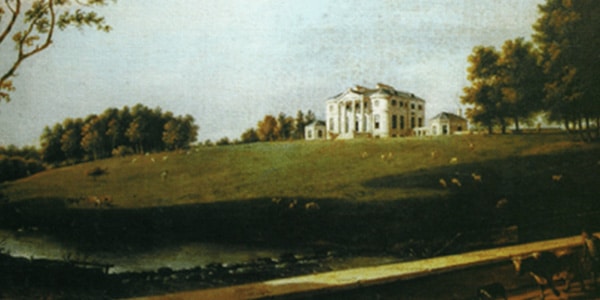
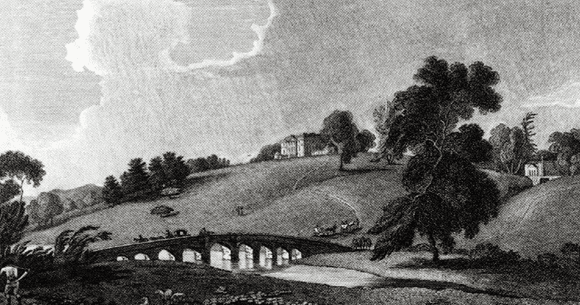
‘House, Bridge and the River Mole’ by Harrison & Co, 1787. Depicts Hopkins’ grand Painshill House at the top of the hill and Hamilton’s smaller house on the far right.
MODEST BEGINNINGS TO GRAND DESIGNS
When Hamilton purchased Painshill in 1738, it included a Vanbrugh-style house built by Gabriel, Marquis du Quesne, the property’s financially ruined former owner. The house was rather modest in size and built approximately twenty years prior to Hamilton’s purchase. It featured three decorative arches, a dovecote, a stable, and modest gardens. The young Mr Hamilton would go on to extend these gardens into a luscious landscape and install a gallery within the house to showcase his collection of paintings and antiquities accumulated on his Grand Tours. Hamilton was the type of gentleman who would rather spend time roaming the grounds than be locked away in a study. Therefore, while the house was not as grand as that which would befit a wealthy gentleman, it was perfect for Hamilton.
Sadly, by 1773, the debts were rolling in thick and fast, and Hamilton was forced to sell the property to Benjamin Bond Hopkins. Hopkins had grander tastes than his predecessor, and Hamilton’s modest home wasn’t nearly impressive enough. He employed architect Richard Jupp to design him a new home, higher up the hill. This would become Painshill House. It was larger and more extravagant than Hamilton’s – the type of house that would draw attention and loom impressively over the landscape. It boasted a columned portico with Corinthian-style capitals and a frieze of elegantly carved stone blocks. Although the property was a feat of late 18th century architecture, it evoked an undeniable sense of the classical world. Given Hamilton’s fascination with all things ancient, perhaps he would have admired his successor’s architectural choices.
Painshill House painting by Theodore de Bruyn, 1789.
SCATTERED STONES AND A RUINED TEMPLE
Unfortunately, the classical beauty of Painshill House wasn’t to last. Exactly 100 years after Hopkins had purchased the landscape and determined Hamilton’s house too small, Painshill fell into the hands of another man with strong architectural notions. In 1873, Charles James Leaf purchased Painshill House and its surrounding follies. To him, the columned portico and the stone frieze were too classical for his Victorian sensibilities. Once again, an architect was employed to remedy the structural sins of the previous owners. Norman Shaw, an architect acclaimed for his work on country manors, began to dissect Painshill House.
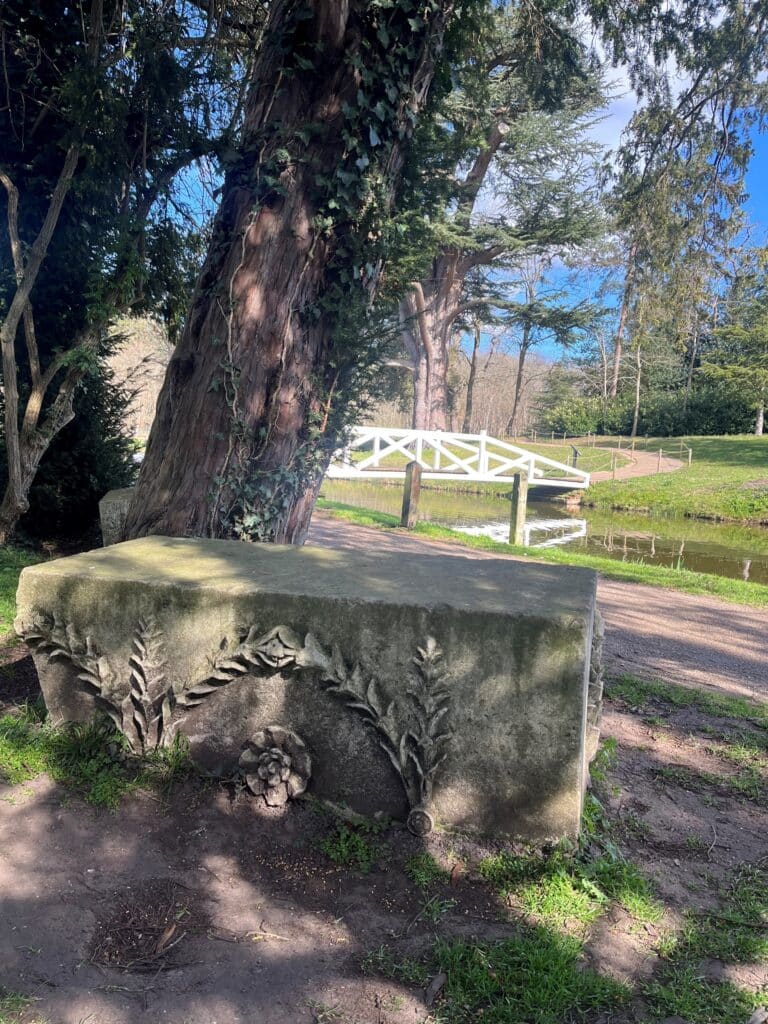
An elegantly carved stone block from Hopkins’ portico frieze. Like many others since Leaf’s ownership, it sits resolutely on the banks of the Serpentine Lake.
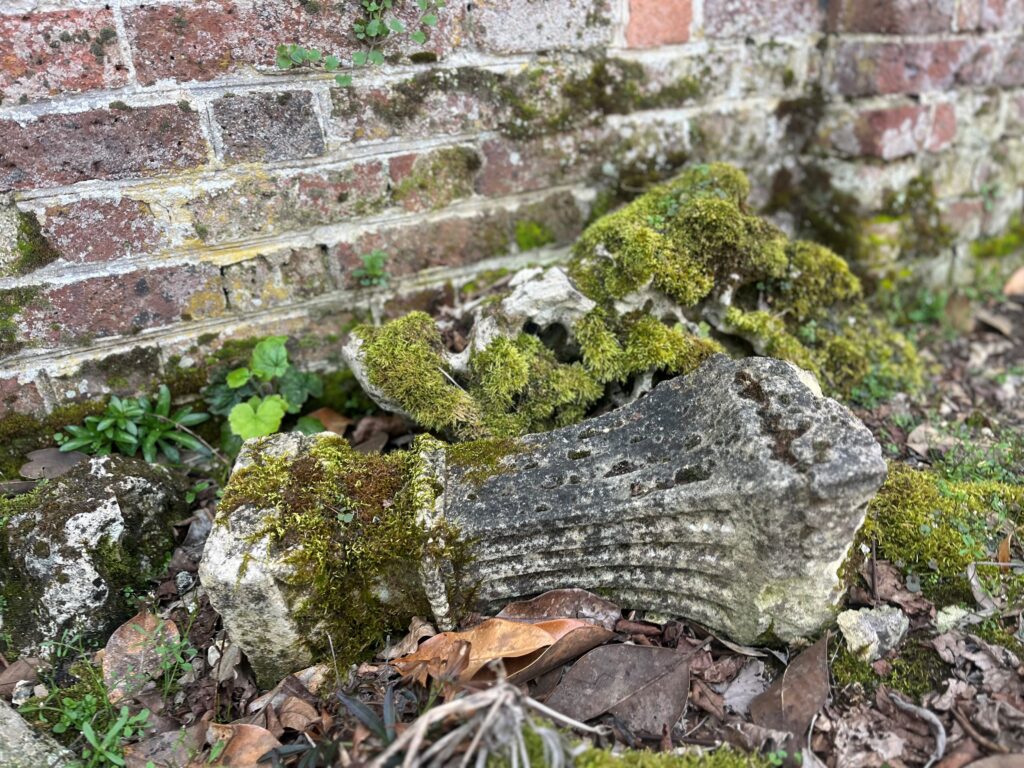
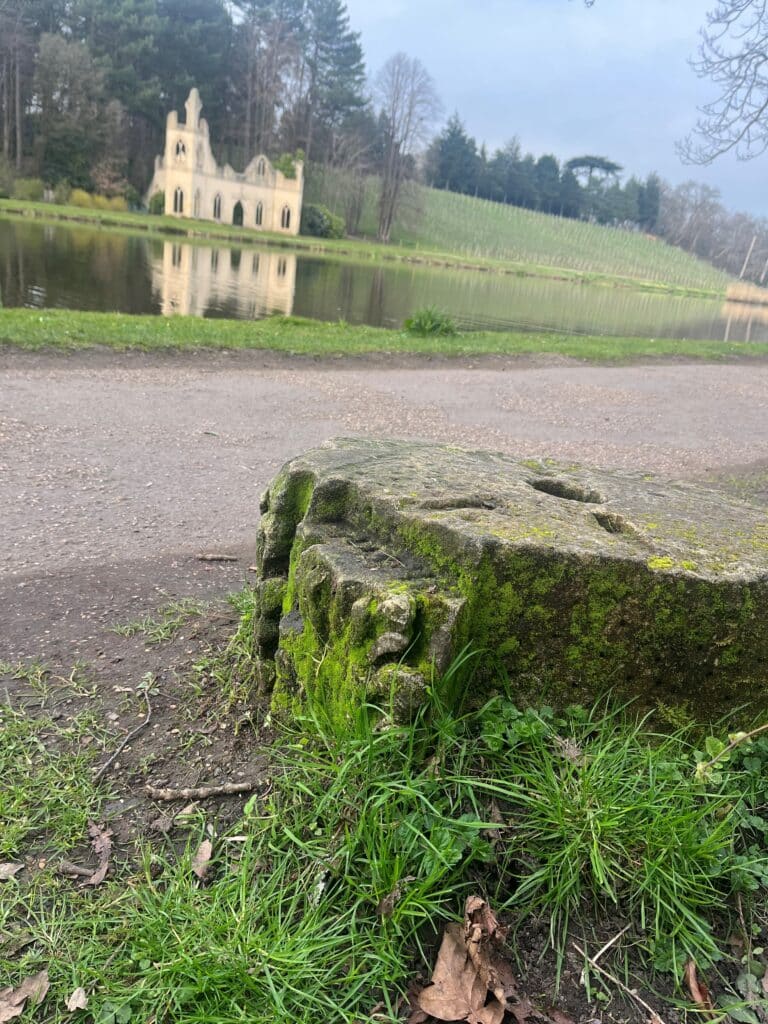
He replaced the stunning northern pavilion with bland servants’ quarters. The grand portico was destroyed in favour of a veranda and the elegantly carved stone blocks that comprised the frieze were taken and scattered haphazardly around the park. Today, if you wander around the Serpentine Lake, you will notice these heavy blocks, remnants of Hopkins’ original vision. Sadly, their placement is random, often backwards or upside down. Leaf and Shaw had such little regard for the stones that they didn’t consider their engravings to be worthy of admiration. In a very recent discovery, some pot shards and grotto debris were found in Painshill’s Kitchen Garden. A section of one of Hopkins’ column capitals was hiding amongst the fragments. See if you can spot it next time you’re in the Kitchen Garden.
A column capital from Hopkins’s portico abandoned in the Kitchen Garden.
The final sacrilege against Painshill occurred during the roaring ‘20s. By now, Painshill was owned by the vibrant Ethel Combe, who had taken on the land upon widowhood. Her elderly husband had passed away, leaving Ethel with the option of remarrying and redoing her beloved Painshill. In 1925, revivalist architectural styles were back in fashion, and archaeological discoveries were piquing Britain’s curiosity. Perhaps it was this that inspired Ethel to revive the ancient façade of Painshill House.
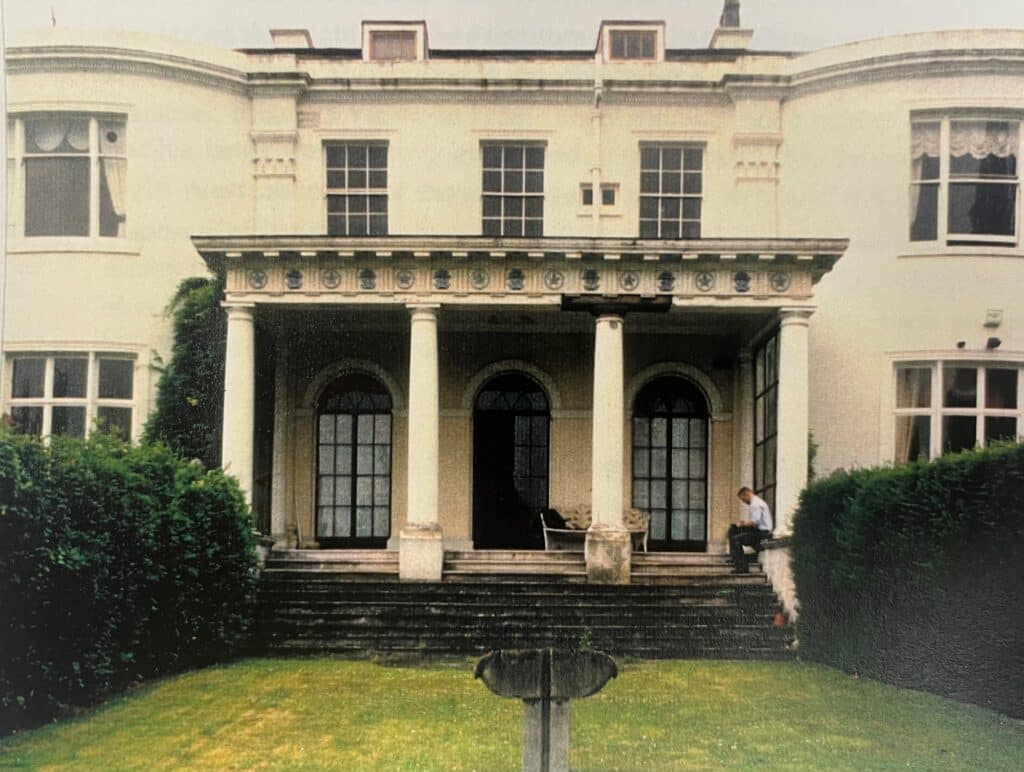
Photograph from the 1990s showing Ethel Combe’s loggia on Painshill House. The frieze and columns were ripped from the Temple of Bacchus.
Ethel had a vision of a classical loggia, not as grand as Hopkins’ portico, but certainly more remarkable than Leaf’s veranda. Unfortunately, she did not have the budget to carry out the renovation and so she had to come up with an alternative method for construction. In a move that would no doubt be considered sacrilegious to a modern historian, Ethel had the material ripped from Hamilton’s Temple of Bacchus. She removed the entire frieze and repurposed it to build her loggia. The temple, which was 163 years old by 1925, was ruined. This wasn’t the first time that Ethel had repurposed materials from Hamilton’s follies. In 1907, she took rocks from the Cascade to build an Edwardian rockery on the old vineyard slope. Although she loved Painshill, she seemed to hold no qualms about destroying older-style follies in favour of newer, on-trend structures.
The grounds of Painshill largely fell to ruin in the wake of World War II. After Ethel handed the property over to support the war effort, Painshill House became separated from the grounds. In the 1980s, when the landscape was being revived by archaeologists, Painshill House was converted into 6 flats. While it no longer stands within the park’s boundaries, it can still be seen through the trees – a grand white structure that the landscape’s owners once called home. Unfortunately, Hamilton’s modest house hasn’t been so lucky. Mere ruins can just about be spotted from the very edge of the park.
Painshill House is a tale of scattered stones and historical devastation, repurposed ruins and numerous renovations. The building blocks still stand obstinately within Painshill’s soil, waiting to be admired and trailed around the lake.
The lower section of a column capital from Hopkins’ portico.
History can be a little rocky…Find out how Painshill was affected by the Edwardian rockery craze.
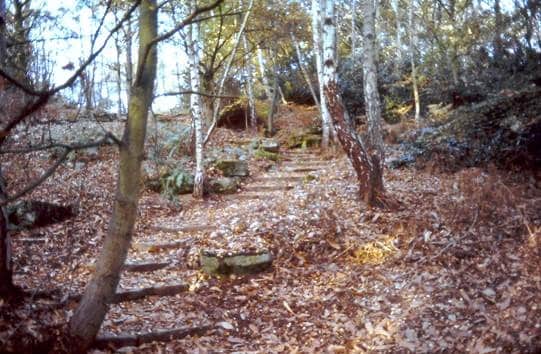
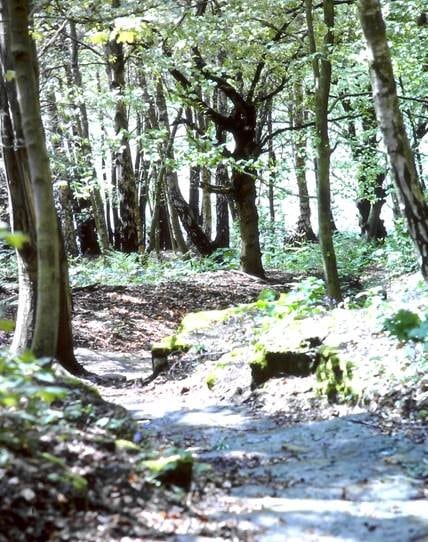
The rockery is one of Painshill’s best-kept secrets. If you search for it today, you’ll find essentially no trace of it within the park’s vast landscape. In the archive rooms, you could scan documents for hours and find no more than a passing mention of it. The search becomes even more complicated when you factor in the various names that it has gone by. Rumours of ‘a rockery’, ‘a rock garden, ‘rustic steps’, and ‘rockery steps’ have all been used to describe this mysterious feature at Painshill.
Painshill’s rockery in 1982.
What exactly is a rockery?
The history of rockeries can be traced back to ancient East Asia. Chinese and Japanese gardens implemented rocks for decorative, philosophical, and spiritual purposes. English rockeries were typically created to showcase alpine plants and create the illusion of mountainous environments. The first is often cited to be The Pond Rockery at Chelsea Physic Garden. It was built in 1773 but was considerably ahead of its time as rockeries didn’t gain popularity until the 1830s. In the Victorian and Edwardian periods, rockeries sprang up everywhere. There was such a significant boom in demand that companies such as Pulham & Son became famed for installing entire rock gardens. The craze was so prominent that innovation was needed. Pulham & Son developed a type of artificial rock that became known as pulhamite. This offered durability at a lower cost. Some clients, however, didn’t want to pay a penny and found alternative means of acquiring rocks – Painshill’s Edwardian owners were no exception.
The rockery in June 1983.
The Vineyard Era
Painshill’s rockery had a unique journey. When Charles Hamilton was creating his landscape here in the 18th century, rockeries were not yet in fashion. On the north side of the lake, he had a large slope with south-facing views. In a rather ambitious undertaking – and certainly one of the first to be attempted on English soil – Hamilton established a vineyard. He planted the vines between 1740 and 1743 with just two burgundy grapes – an Auvernat (Pinot Noir) and a Miller Grape (Pinot Meunier).
After enduring a few challenging years, Hamilton realised he needed an experienced vigneron for the vineyard to be successful, and so he hired Frenchman David Geneste. Geneste had all the right credentials – he grew up on an ancestral vineyard – and yet it appears he didn’t know quite as much about the business as Hamilton thought. Geneste would frequently write to his sister, Marie Broderie, for help. She had inherited the family vineyard and was considerably more knowledgeable than her brother. With the information and equipment that she provided, the vineyard produced several successful wine varieties.
In 1773, Hamilton sold Painshill to Benjamin Bond Hopkins, who ensured that the vineyard was maintained in good condition. No wine was produced during Hopkins’s ownership, but he preserved the vineyard for its aesthetic value. When he died in 1794, the vineyard was swiftly neglected. Utilitarian attitudes of the early 19th century had replaced the whimsical frivolity of Hamilton’s era and by 1834, the slope was covered in Scotch pines.
The vineyard was nothing but a memory.
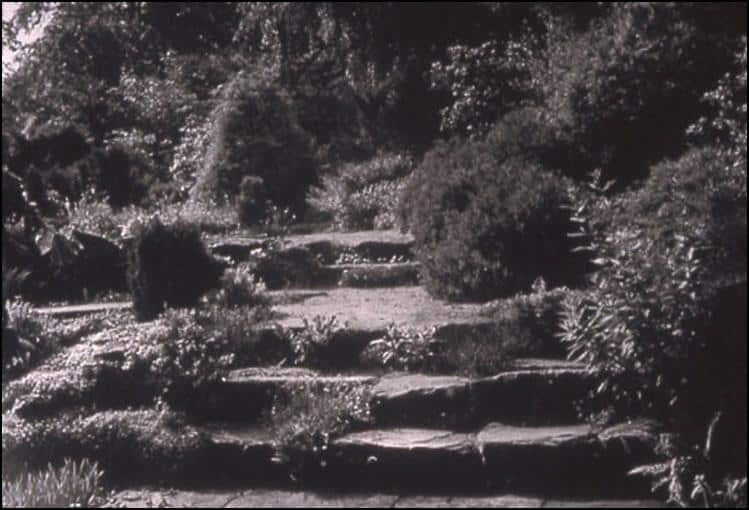
The rockery in the 1930s.
The Edwardian Rockery
The rockery was the creation of the beautiful Ethel Combe. Ethel took over Painshill after the death of her husband, Alexander Cushney. Cushney had been four decades older than his wife, and so when he passed away in 1903, Ethel remarried. Her second husband was Charles Combe. His family owned the Cobham Park Estate, but Ethel’s heart remained at Painshill. She insisted that her new husband join her, and together they adapted Painshill to suit Edwardian tastes. Rockeries were incredibly en vogue, and Ethel decided that she must have one. Presumably to avoid extortionate costs, the couple decided to take the rocks from Hamilton’s original Cascade and move them to the neglected vineyard. By 1907, they had their very own rockery.
The old vineyard was the perfect spot. Its high slope and south-facing orientation offered the ideal elevation and sunlight for alpine plants to thrive. From the top of the slope, the Cascade rocks were used to create steps that led the visitor downwards, forking at intervals and allowing the plants to be admired against the backdrop of the sparkling lake. Photographs from the 1930s depict the rockery in good condition. It likely remained so until 1939, when Painshill was requisitioned to support the war effort and the landscape was neglected.
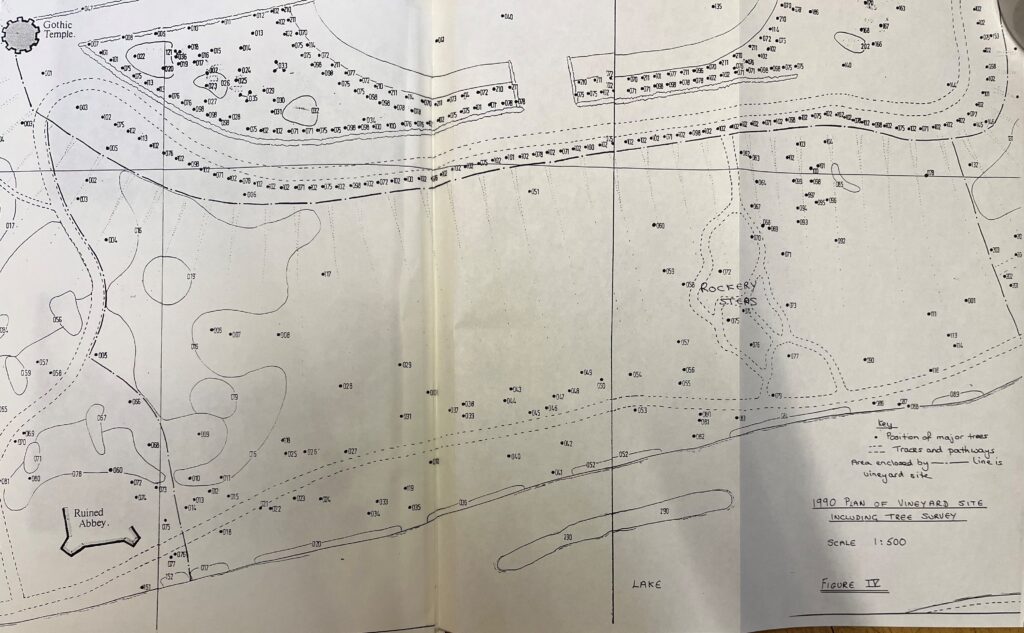
A plan of the rockery drawn in 1990.
Archaeologists in the 1980s wanted to restore Painshill to Hamilton’s original vision. And so, even though the rockery had largely survived, plans were made to clear the trees and plants, remove the rock steps, and replant the vineyard. Clearance began in December 1990, and by the end of January, the rocks had been removed for £220 and were inspected by an archivist for a further £150.
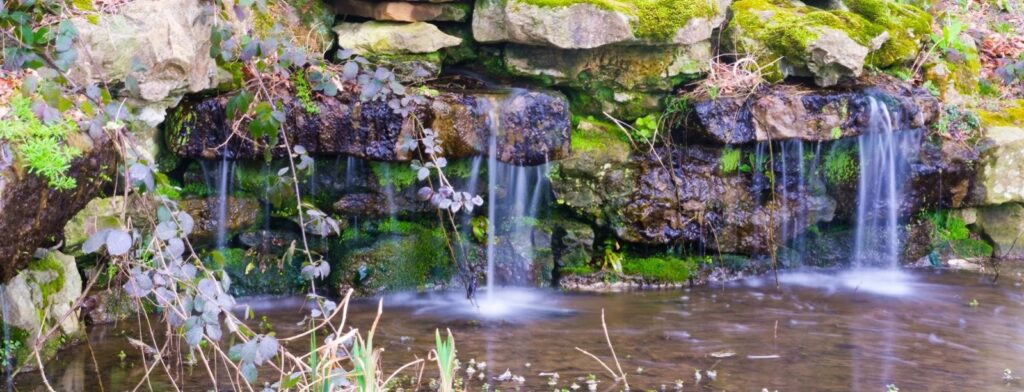
In Spring 1992, the vineyard was restored and has remained an essential part of Painshill’s legacy ever since. The vineyard was a key feature of Hamilton’s vision and a unique chapter in English winemaking history, but it is unfortunate that a surviving Edwardian rockery became collateral damage in the restoration endeavour. Due to the lack of interest in the rockery in the late 20th century very little information about it survives. Although the rockery no longer exists, the pieces that made it have been moved back to the Cascade, where they can still be seen today.
The rocks were taken from the rockery to rebuild Hamilton’s Cascade in the 1990s.
Painshill was no stranger to 18th century bathing trends. Dip into the history of our Roman Bath.
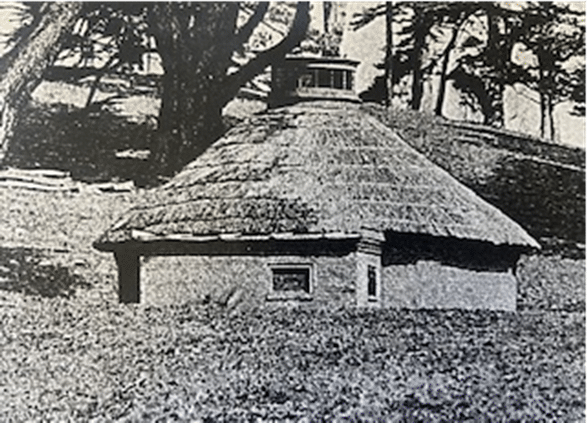
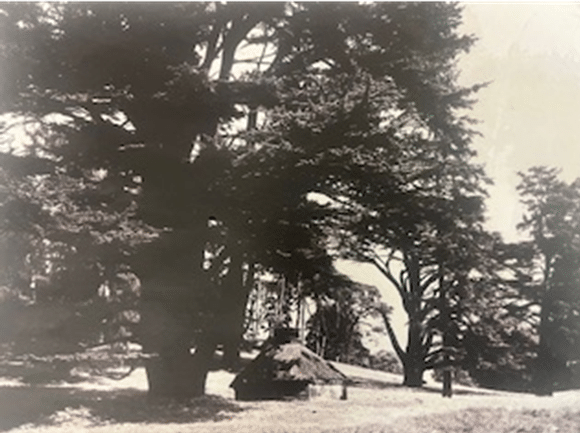
A close-up of the Roman Bath (external) in 1937.
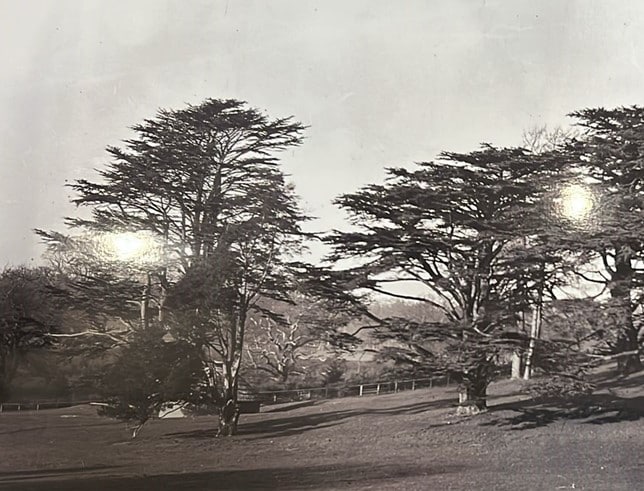
It’s no secret that Charles Hamilton, the park’s founder, was inspired by his Grand Tours across Europe. The influence of his travels can be found throughout Painshill – from the Ruined Roman Arch to the Temple of Bacchus, the park exudes a beautiful, eccentric admiration for mythology and ancient architecture. This blend of 18th century history with the classical world is rooted in the park’s identity. And yet, on the northside of the lake, situated just below the Great Cedar Tree, is a well of brickwork buried beneath foliage and water. Nowadays, it is easy to mistake this structure for a pond, the eye drawn to the ducks paddling on the surface rather than the ruins beneath.
This is the Roman Bath. A fascinating piece of Painshill’s forgotten history.
After World War II, the park fell into ruin, materials were scavenged and repurposed for local uses, and nature engulfed Hamilton’s vision. When archaeologists began restoration works in the 1980s, they had to decide where to focus their efforts. Priority was given to the structures built between 1738 and 1773, the years of Hamilton’s ownership. The Roman Bath belongs to Painshill’s second chapter. The years in which it was owned by Benjamin Bond Hopkins, a wealthy gentleman who built himself a large house and continued the park’s development.
The earliest photograph of the Roman Bath in 1899.
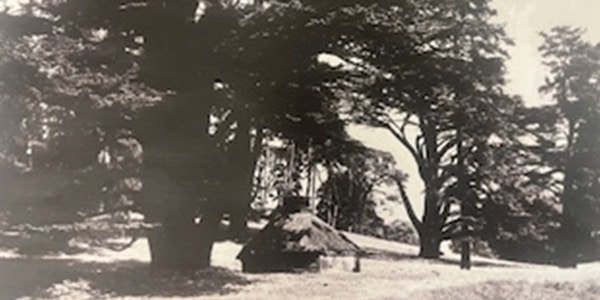
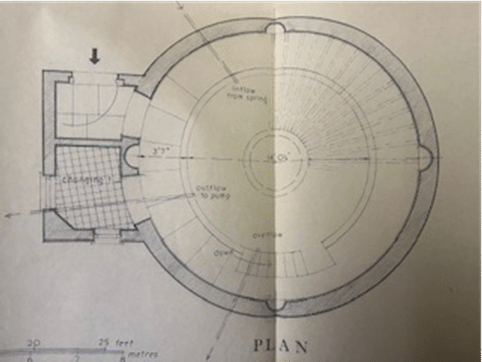
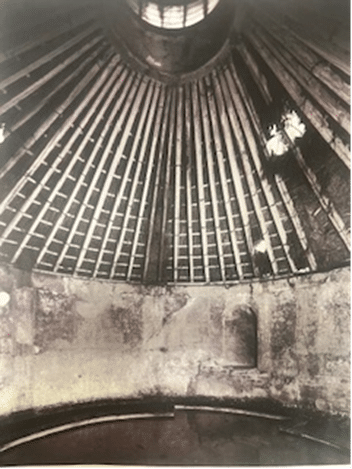
In the 18th century, medicinal bathing was popularised and visits to spa towns like Bath or Buxton were fashionable. Between 1780 and 1790 Hopkins decided to build his own bathhouse inspired by Ancient Roman ones. It was made of brick with a thatch roof and a rather ‘unroman’ stained glass lantern allowing light inside. Hopkins would have entered via the north side of the building where he would have passed through a small antechamber that likely served as a changing room. The main room consisted of white tiled walls and flagstone flooring. Four depressions in the walls may have housed Roman-inspired statues and added to the classical ambience of the space. It was a circular room with a 3 ft 7 in internal pathway spanning the circumference while the bathing depression was 14 ft wide and 5 ft deep. Hopkins would have descended into the bath via a set of stairs, submerging himself in cold water supplied from a spring located to the North-West of the structure. Later, in the 1860s, a horse-powered engine was installed to pump water between the bath and the house that had previously belonged to Hopkins.
A floorplan showcasing the internal layout of the Roman Bath.
The exact date that the Roman Bath fell into ruin is unknown. It was last photographed in 1937 showing that the structure was still intact before the outbreak of World War II. An account from an employee, Joy Terry, who used to live on the site, suggests that the Roman Bath may have been in reasonably good condition as late as 1948. At which time, the walls were said to have been painted a decorative blue. After this, the ruin of the Bath slips into mystery. The thatch roof came down and the brickwork fell into disrepair. As this was not a part of Hamilton’s initial historic route it has never been restored to its original state.
The interior of the Roman Bath pictured in 1937.
The brick depression still lies beneath the Great Cedar Tree waiting for its restoration. The Roman Bath represents a forgotten page in Painshill’s history – a charming relic of Grand Tours and 18th century fascination with the ancient world. A little patch of Rome right here in Surrey.
The Roman Bath pictured in 1937 beneath the Great Cedar Tree.
Painshill has a 2,000-year-old secret… Discover the lost altar and the mysterious young woman whose ashes it held.
Translation of inscription by Dr Susan Walker: “Vesonia Procula, Daughter Of Cnaeus, A Citizen Of Iesso in Nearer Spain, Aged 23, Lies Here. Julius Natalis (Set This Up) To His Most Excellent And Deserving Wife.”
Like many young men of the 18th century, Charles Hamilton embarked on Grand Tours across Europe. On his travels, he became captivated by Rome and purchased a collection of artefacts from ancient sites. Today, this practice would be considered heinous by archaeologists and historians, but at the time it was commonplace for wealthy gentlemen to acquire relics and ship them back to England. This would have been at considerable cost, as many such items were heavy and unwieldy. Indeed, some of the ‘artefacts’ would even have been fakes, created and sold by locals to capitalise on foreign fascination with classical antiquity.
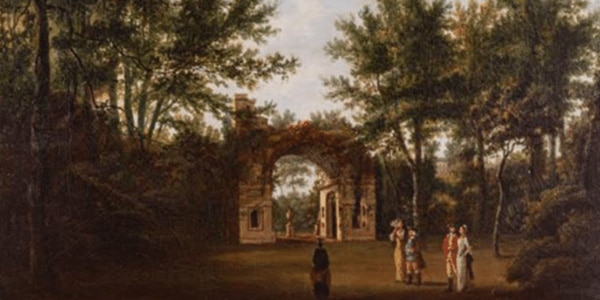
When he was in his twenties, Hamilton acquired a beautiful altar during one of his Grand Tours. He would have taken it from Rome in either 1725 or 1732 and when he purchased Painshill, he brought it with him to sit beneath the Ruined Roman Arch. It appears there, on the western side of the lake, in contemporary 18th century paintings. The Arch was likely constructed by Hamilton in the 1750s and was inspired by the architecture he admired during his travels. Perhaps in placing the altar beneath it he hoped to add a degree of authenticity to his modern ruin.
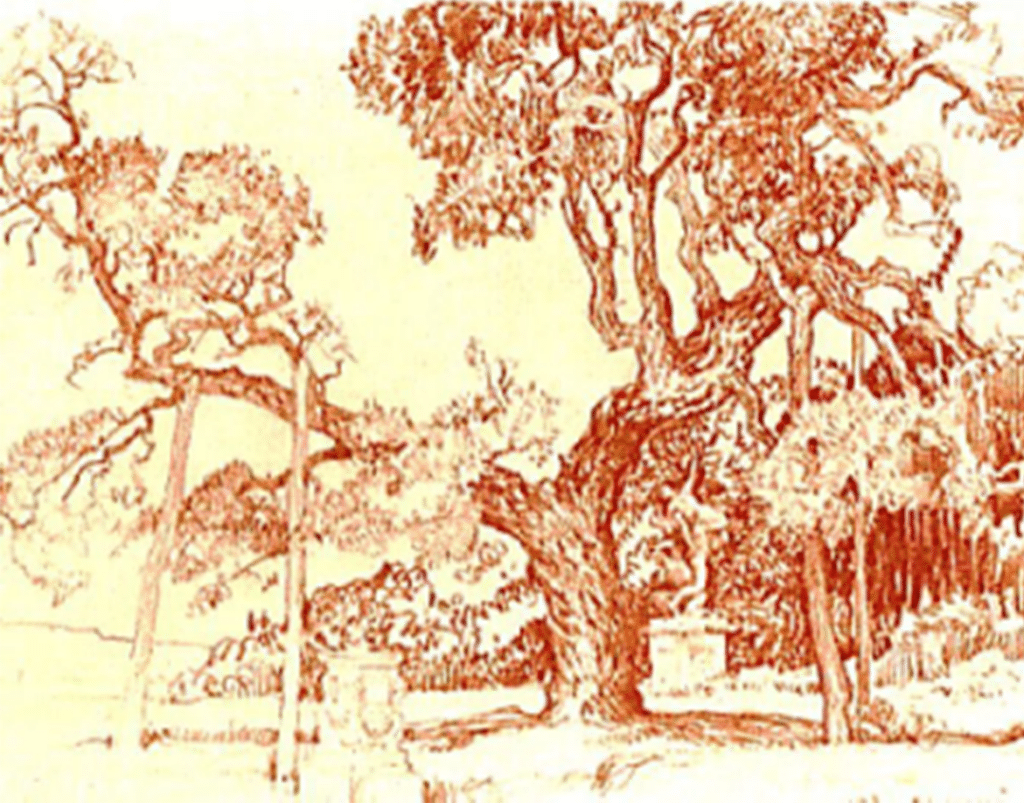
The Roman Altar depicted on the Great Lawn next to a statue of the Abduction of a Sabine Woman. ‘Altar and Cork Tree‘ sketched in 1950 by Sir William Russell Flint.
THE MYSTERY OF THE LOST ALTAR
Sir William Russell Flint sketched Painshill in 1950, not long after World War II. From his drawings, we can see that by the mid-20th century, the altar had been moved to the Great Lawn and positioned not far from a statue portraying the Abduction of a Sabine Woman. This is the last depiction available of the Roman Altar within the bounds of Painshill. For decades, this ancient relic became lost and the park fell to utter ruin.
In the 1980s, as archaeologists began putting Painshill back together, one piece of the puzzle was notably missing: The Roman Altar. It wasn’t beneath the Ruined Roman Arch nor on the Great Lawn. And despite considerable efforts to manicure the grounds, it remained lost. Had the altar been stolen? Destroyed? Or totally lost as nature engulfed Hamilton’s landscape?
Around the same time, Painshill House, built by Benjamin Bond Hopkins (the park’s second owner), was being converted into six luxurious flats. This building was no longer within the borders of the park and its secrets remained beyond the reach of the archaeologists.
Decades later, in 2018, when the Roman Altar was all but forgotten, a gentleman approached staff at Painshill with some exciting news. He was a resident of Painshill House and he had a rather interesting garden decoration that had been situated on the property for many years. Inspection of the piece revealed it to be the lost altar, and, in an exciting twist of fate, it was found to be a genuine Ancient Roman artefact. Based on similar artefacts, the British Museum have dated it to the reign of Emperor Trajan who ruled between 98 CE – 117 CE. This suggests that the altar is almost 2,000 years old, making it Painshill’s oldest artefact. After inspection, the altar was returned to Painshill where it could undergo research and conservation and eventually be put on display for the public to enjoy.
The Roman Altar photographed in the garden of Painshill House.
THE MYSTERIOUS DEATH OF VESONIA PROCULA
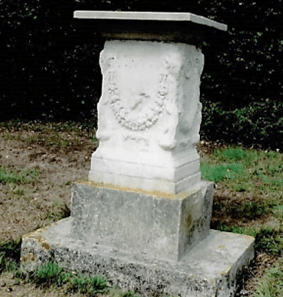
Recovery of the altar allowed City & Guilds of London Art School student Gabrielle Nohr to carry out conservation efforts, which were completed in 2025. Her research helped contextualise and uncover the secrets of the lost altar. The altar is made of white marble and at one time it would have held the cinerary urn of the deceased. The central Latin inscription reveals that this altar belonged to a young woman. It would have been a place to keep her ashes secure after cremation and allowed her loved ones to honour her with offerings. Sculpted into the exterior are stunning motifs invoking imagery of the natural world. An imperial eagle, ram heads, swans, garlands and more.
This particular altar was for a young woman named Vesonia Procula. She died at 23 years old and the altar was commissioned by her husband, Julius Natalis. We know very little about her short life. Her father is cited to be a man called Cnaeus who heralded from Iesso, Spain, which is located near modern-day Barcelona. Vesonia is described by her husband as his “most excellent and deserving wife.” This kind of language was commonly used to describe the deceased in Ancient Rome but the endearment does imply affection between Julius and Vesonia. The tragedy of her untimely death remains a mystery. It is possible that Vesonia died during labour (her age would place her within prime childbearing years), perhaps she fell ill, or maybe she endured a tragic accident.
The circumstances of her death will likely remain one of Painshill’s unsolved mysteries but hopefully, when her funerary altar is rehoused, sheltered from the elements in Painshill’s Visitor Hub, Vesonia’s story will be appreciated for years to come. The funerary altar of this young woman has absolutely served its purpose over its 2,000-year lifespan. It has accounted Vesonia’s journey from Iesso, to Rome, and eventually to Painshill and cemented her legacy for many years to come.
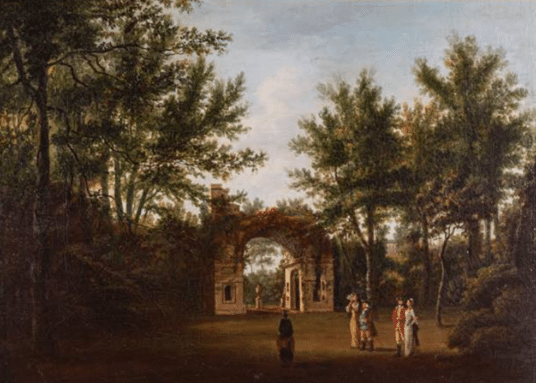
Visitors admiring the Roman Altar beneath the Ruined Roman Arch in Painshill Park. Painting attributed to William Hannan, 1770.