TALES OF PAINSHILL HOUSE
By Georgia Wilkinson
Narrated By Nicola Barranger
Scattered stones and a ruined temple. Welcome to Painshill House.
In the 1700s, Painshill Park was experiencing its cultural heyday. Illustrious guests would explore Charles Hamilton’s landscape and remark on the stunning utopia he had created. Like those before them, visitors today are welcome to roam through the temples, ruins, and follies, but they are often left wondering where the grand house is. Surely, the owner of Painshill would have wanted to live in this paradise, residing amongst the vibrant plantings, picturesque structures, and the glittering lake.
While it’s true that you won’t find a manor within the boundaries of the park today, there certainly was (and still is) a Painshill House.
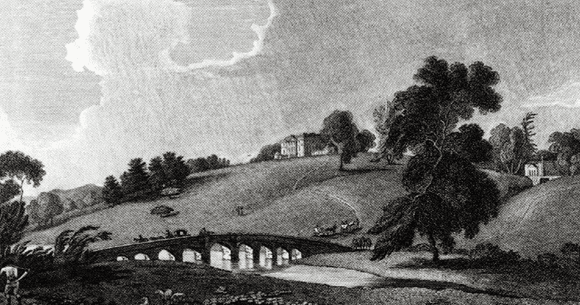
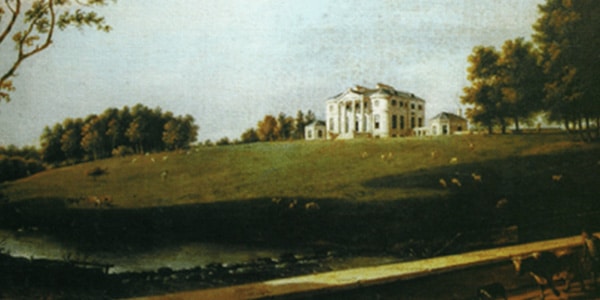
‘House, Bridge and the River Mole’ by Harrison & Co, 1787. Depicts Hopkins’ grand Painshill House at the top of the hill and Hamilton’s smaller house on the far right.
MODEST BEGINNINGS TO GRAND DESIGNS
When Hamilton purchased Painshill in 1738, it included a Vanbrugh-style house built by Gabriel, Marquis du Quesne, the property’s financially ruined former owner. The house was rather modest in size and built approximately twenty years prior to Hamilton’s purchase. It featured three decorative arches, a dovecote, a stable, and modest gardens. The young Mr Hamilton would go on to extend these gardens into a luscious landscape and install a gallery within the house to showcase his collection of paintings and antiquities accumulated on his Grand Tours. Hamilton was the type of gentleman who would rather spend time roaming the grounds than be locked away in a study. Therefore, while the house was not as grand as that which would befit a wealthy gentleman, it was perfect for Hamilton.
Sadly, by 1773, the debts were rolling in thick and fast, and Hamilton was forced to sell the property to Benjamin Bond Hopkins. Hopkins had grander tastes than his predecessor, and Hamilton’s modest home wasn’t nearly impressive enough. He employed architect Richard Jupp to design him a new home, higher up the hill. This would become Painshill House. It was larger and more extravagant than Hamilton’s – the type of house that would draw attention and loom impressively over the landscape. It boasted a columned portico with Corinthian-style capitals and a frieze of elegantly carved stone blocks. Although the property was a feat of late 18th century architecture, it evoked an undeniable sense of the classical world. Given Hamilton’s fascination with all things ancient, perhaps he would have admired his successor’s architectural choices.
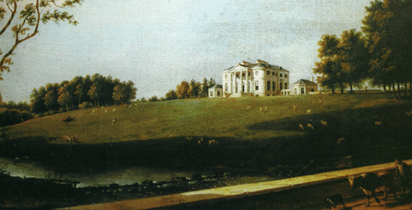
Painshill House painting by Theodore de Bruyn, 1789.
SCATTERED STONES AND A RUINED TEMPLE
Unfortunately, the classical beauty of Painshill House wasn’t to last. Exactly 100 years after Hopkins had purchased the landscape and determined Hamilton’s house too small, Painshill fell into the hands of another man with strong architectural notions. In 1873, Charles James Leaf purchased Painshill House and its surrounding follies. To him, the columned portico and the stone frieze were too classical for his Victorian sensibilities. Once again, an architect was employed to remedy the structural sins of the previous owners. Norman Shaw, an architect acclaimed for his work on country manors, began to dissect Painshill House.
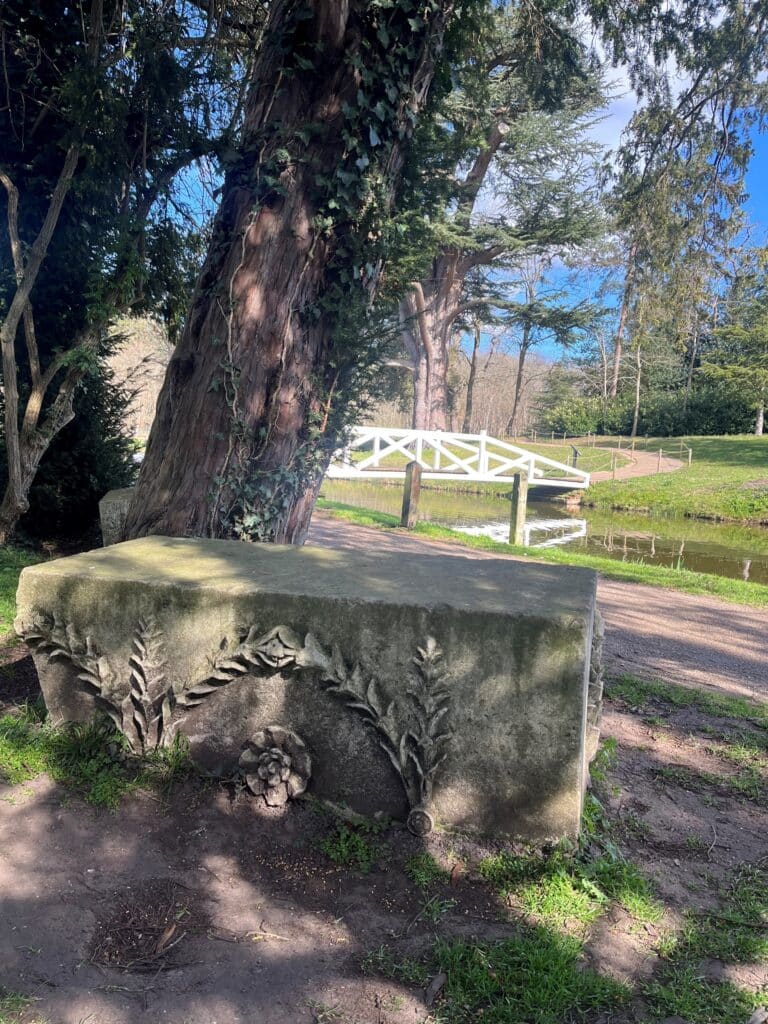
An elegantly carved stone block from Hopkins’ portico frieze. Like many others since Leaf’s ownership, it sits resolutely on the banks of the Serpentine Lake.
He replaced the stunning northern pavilion with bland servants’ quarters. The grand portico was destroyed in favour of a veranda and the elegantly carved stone blocks that comprised the frieze were taken and scattered haphazardly around the park. Today, if you wander around the Serpentine Lake, you will notice these heavy blocks, remnants of Hopkins’ original vision. Sadly, their placement is random, often backwards or upside down. Leaf and Shaw had such little regard for the stones that they didn’t consider their engravings to be worthy of admiration. In a very recent discovery, some pot shards and grotto debris were found in Painshill’s Kitchen Garden. A section of one of Hopkins’ column capitals was hiding amongst the fragments. See if you can spot it next time you’re in the Kitchen Garden.
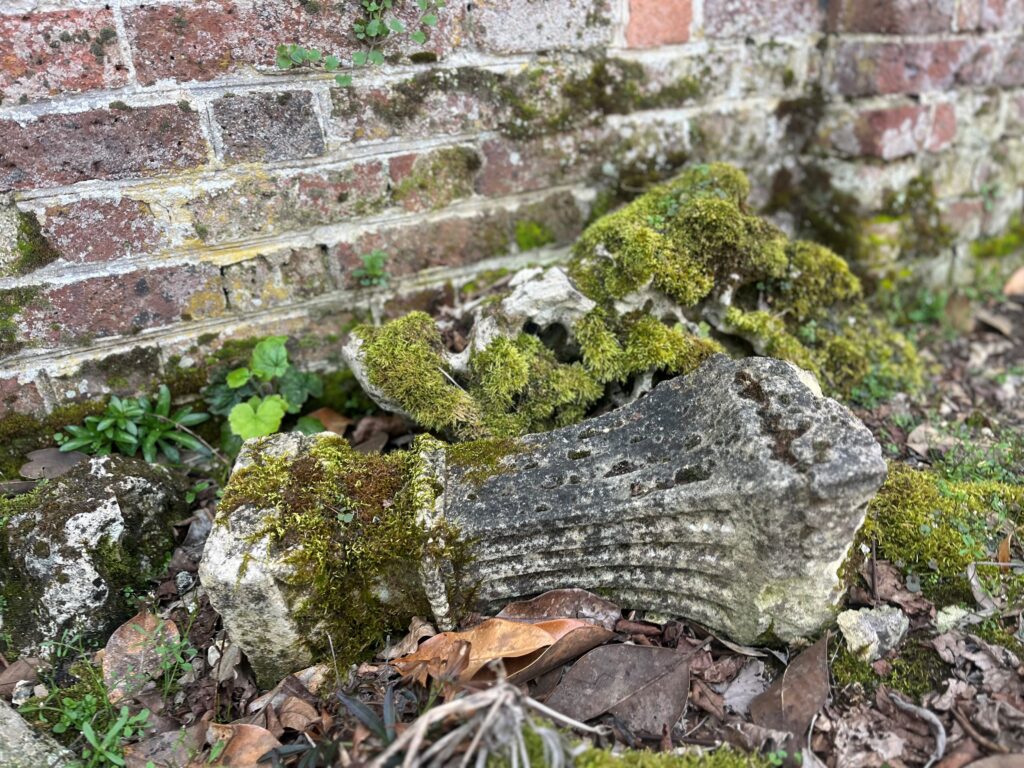
A column capital from Hopkins’s portico abandoned in the Kitchen Garden.
The final sacrilege against Painshill occurred during the roaring ‘20s. By now, Painshill was owned by the vibrant Ethel Combe, who had taken on the land upon widowhood. Her elderly husband had passed away, leaving Ethel with the option of remarrying and redoing her beloved Painshill. In 1925, revivalist architectural styles were back in fashion, and archaeological discoveries were piquing Britain’s curiosity. Perhaps it was this that inspired Ethel to revive the ancient façade of Painshill House.
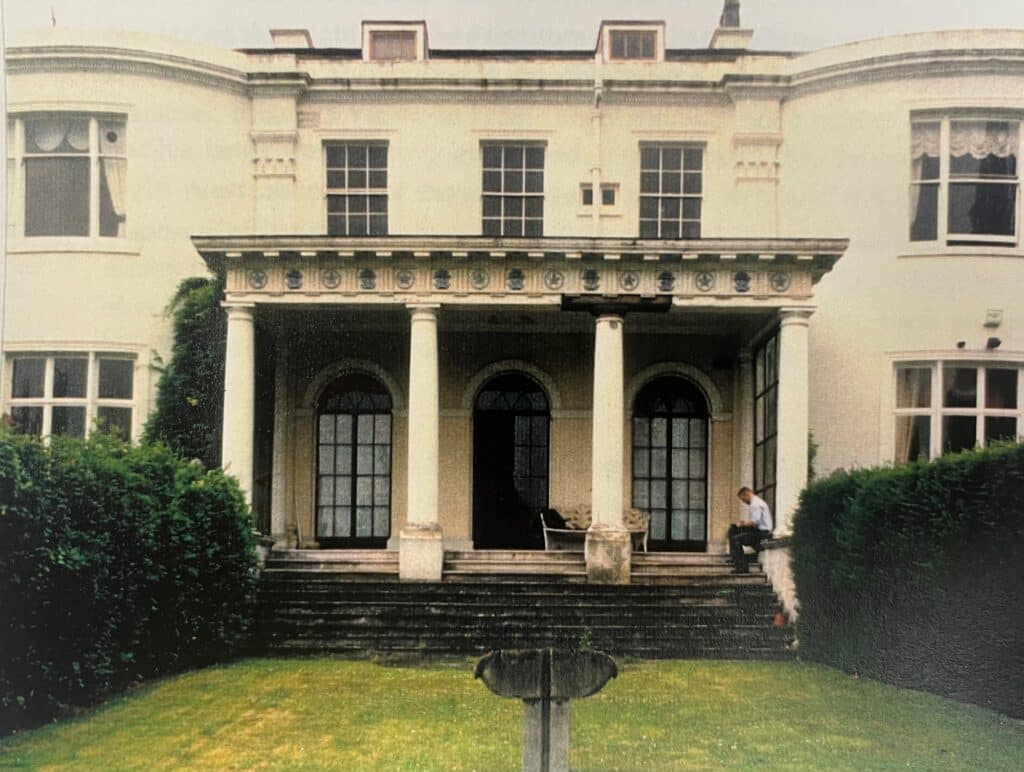
Photograph from the 1990s showing Ethel Combe’s loggia on Painshill House. The frieze and columns were ripped from the Temple of Bacchus.
Ethel had a vision of a classical loggia, not as grand as Hopkins’ portico, but certainly more remarkable than Leaf’s veranda. Unfortunately, she did not have the budget to carry out the renovation and so she had to come up with an alternative method for construction. In a move that would no doubt be considered sacrilegious to a modern historian, Ethel had the material ripped from Hamilton’s Temple of Bacchus. She removed the entire frieze and repurposed it to build her loggia. The temple, which was 163 years old by 1925, was ruined. This wasn’t the first time that Ethel had repurposed materials from Hamilton’s follies. In 1907, she took rocks from the Cascade to build an Edwardian rockery on the old vineyard slope. Although she loved Painshill, she seemed to hold no qualms about destroying older-style follies in favour of newer, on-trend structures.
The grounds of Painshill largely fell to ruin in the wake of World War II. After Ethel handed the property over to support the war effort, Painshill House became separated from the grounds. In the 1980s, when the landscape was being revived by archaeologists, Painshill House was converted into 6 flats. While it no longer stands within the park’s boundaries, it can still be seen through the trees – a grand white structure that the landscape’s owners once called home. Unfortunately, Hamilton’s modest house hasn’t been so lucky. Mere ruins can just about be spotted from the very edge of the park.
Painshill House is a tale of scattered stones and historical devastation, repurposed ruins and numerous renovations. The building blocks still stand obstinately within Painshill’s soil, waiting to be admired and trailed around the lake.
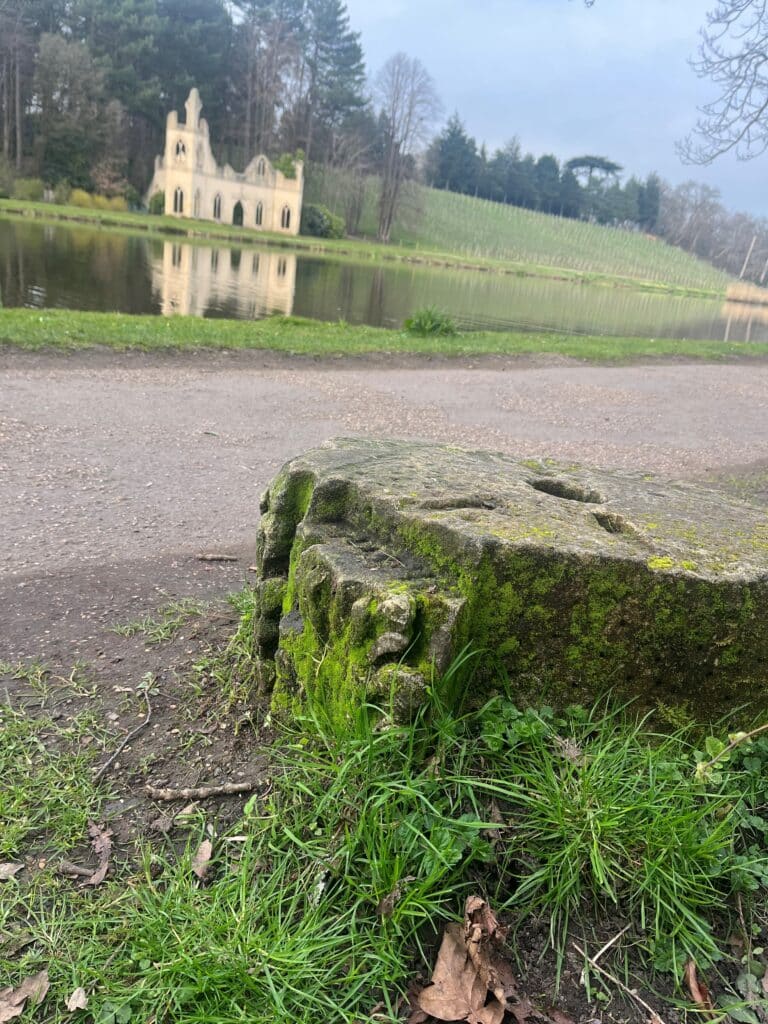
The lower section of a column capital from Hopkins’ portico.