ETHEL COMBE: THE LAST LADY OF PAINSHILL
By Georgia Wilkinson
Narrated by Nicola Barranger
Romance, rockeries, and a ruined temple… Meet the last lady of Painshill.
Painshill has countless mysteries hidden within the follies and the underexplored nooks of the landscape. However, the people who have lived and loved here also carry a myriad of secrets. Painshill’s most famous owner is, of course, its founder Charles Hamilton. But a vivacious woman named Ethel Combe was arguably the most complex. Ethel lived at Painshill for fifty years and oversaw its final chapter before it fell to ruin in the postwar era. Ethel was glamorous and wilful, leaving a lasting impression on the landscape and the wider Cobham community. In some ways, she was a controversial figure. Her adaptations at Painshill resulted in the ruin of two follies. Her romances were unconventional with significant age gaps, and, at times, she found herself a subject of gossip. However, as we shall see, the phrases engraved on the headstones of Ethel and her husband Charles reveal a shared sentiment: that immortality exists in remembrance. So perhaps Ethel would quite like to be remembered for her complexity and impact – these are, after all, the qualities that make her such an interesting figure. Up until now, very little has been written about Ethel, but with evidence gathered from the letters of poet Mathew Arnold, census records, marriage records, and indeed her own headstone, we can finally piece together an image of a charismatic and determined character.
EARLY LIFE AND FIRST MARRIAGE
Alice Ethel Leonard (as she was known then) was born on the 7th of September 1863 to John William Leonard and Fanny Warren. Her father was a merchant in the East India Trading Company. Birth records show that she was born in Norwood, Lambeth, and on later records, she seems to pinpoint the spot to Gipsy Hill. This area derived its name from the large gypsy community that had long been established there. At the time of Ethel’s birth in the mid-19th century, Norwood was undergoing a massive transformation into a suburban community that was expedited by the development of the railway and the iconic Crystal Palace.
Although based in London, she seemed to have solidified herself as a vibrant character on Cobham’s social scene by age 24. As a gorgeous, young, unmarried woman, she was the talk of the village and featured several times in poet Matthew Arnold’s letters to his daughter. Whilst staying in Painshill Cottage, he wrote that everyone in the community agreed that Ethel was stunningly beautiful and commented that “she seems well disposed to enjoy it herself while it lasts.”
It seems that Ethel often found herself at the receiving end of equivocal remarks. She was undoubtedly an attractive and friendly young woman who easily appealed to the opposite sex. Matthew Arnold commented, rather harshly, in December 1887 that he did not think she dressed nor held herself particularly well and yet men still flocked to her. He also noted that Percy Combe danced with her the entire evening, a gentleman who was the son of Charles Combe (Ethel’s future husband). The attention Ethel drew seems to have been sadly accompanied by judgement from the restrained Victorian society of her youth.
Ethel and her family had been staying at Painshill in the winter of 1887 as guests of the new owner, Alexander Cushney. Alexander was a merchant in Shanghai, suggesting that a friendship had been formed between himself and Ethel’s father based on their mutual profession. Alexander and Ethel were an unlikely pair. He was forty years her senior and when their engagement was announced in March 1888, it was met with “disgust and horror” according to Matthew Arnold, although he added that he personally supported the union.
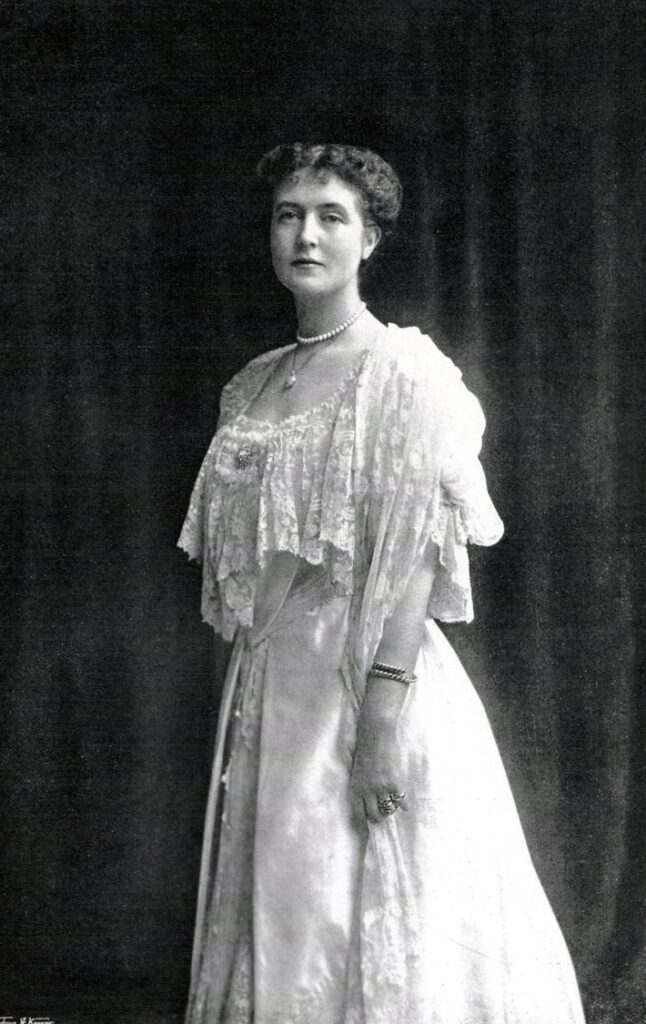
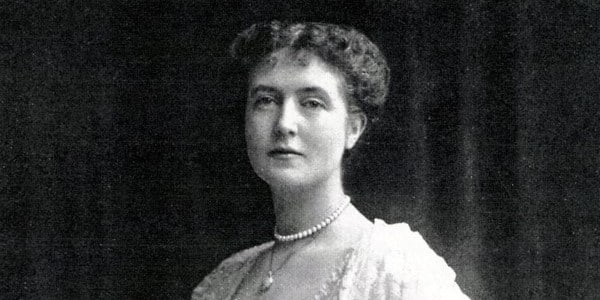
Alice Ethel Combe (1863-1942).
Ethel and Alexander enjoyed a Spring wedding on the 25th of April in St. John’s Wood, Westminster. Her parents served as witnesses and the marriage record reveals that the couple were neighbours on Abbey Road at the time of the wedding. It seems that aside from Painshill, Alexander enjoyed a London residence. Records reveal that Alexander was aged 65 and widowed, having lost his first wife, Isabella Bisset in 1885. Ethel was only 24, making her a similar age to Alexander’s sons. We cannot know for certain whether they married for love or convenience, but as the years flitted by, Ethel once again found herself at the centre of village gossip.
MARRIAGE TO CHARLES COMBE
While at Painshill, the Cushneys were neighbours with the Combe family. In the late 19th century, Charles Combe was the head of this influential family and owner of the Cobham Park Estate. Charles was worldly and fascinating – he had spent a large portion of his youth in France and had travelled the globe during an exciting stint in the army. In 1900, he lost his beloved wife Marianne to scarlet fever. For Charles, this loss seemed insurmountable and he regularly broke down in tears. Sometime after Marianne’s death, Charles began to develop a close friendship with Ethel. Much to the shock of the local community, he would visit her at Painshill while her husband was away. These visits became increasingly frequent and eventually Charles’s family felt compelled to make their disapproval known. Letters reveal that Charles’s daughter, Florence, explicitly told him that the visits with Ethel were causing upset and she pleaded with him to stay away from Painshill. Not only did Charles refuse, but he told his daughter outright that if she continued to disrespect Ethel, he would cast her out of the family home.
Whether Alexander Cushney knew that these visits were occurring and what he thought of them is difficult to say, but in July 1903 he passed away at Painshill, aged 80. Charles and Ethel waited three and a half years to marry after Alexander’s death. They wed at Marylebone Church on the 29th of December 1906. The marriage registry does not list their ages, but simply describes them as being of ‘full age’. Ethel would have been 43 and Charles 70 at the time of their marriage.
In the years since Alexander’s death, Ethel had desperately missed Painshill and urged Charles to buy the estate. He agreed and soon Ethel found herself living in Painshill House once again. In her time away, it appears Ethel had been planning – deciding how to modernise and adapt the landscape to her taste. Ethel had returned as Painshill’s mistress for the second time, older and with greater authority.
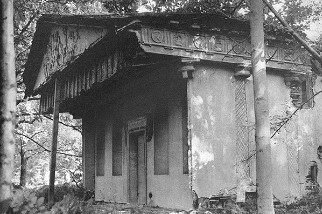
Ethel removed the columns and frieze from the Temple of Bacchus to build a classical loggia on the front of Painshill House.
ADAPTATION OF THE FOLLIES
In 1907, Ethel took the rocks from Hamilton’s Cascade and used them to build her own rockery where the overgrown vineyard had been. The vineyard hadn’t been cared for in a century and so perhaps Ethel thought she was giving Painshill’s south-facing slope a new lease on life. Rockeries were incredibly popular in the Edwardian era and she repurposed the cascade rocks to create steps that led the visitor downwards through a garden of alpine plants.
Ethel’s changes at Painshill extended beyond the aesthetic. To adapt to the financial demands of the 20th century, she grew timber for sale as well as fresh fruit and vegetables in the Walled Gardens. This produce was sold at market, displaying innovation and financial savvy to overcome a tightening budget. Perhaps it was economic pressures that eventually led Ethel to make her most controversial decision at Painshill.
When Charles Combe died in 1920, Ethel was widowed for the second and final time. On the census record, a year later, Ethel’s position had originally been listed as ‘widow’, but this was scratched out and replaced. ‘Head of the Household’ was the title most befitting Ethel Combe. In 1925, inspired by paintings of the original portico on Painshill House, Ethel created her own classical loggia at the front entrance. Instead of purchasing new materials to bring this vision to life, Ethel removed the columns and frieze from the Temple of Bacchus. The Temple, which had survived since the early 1760s was left in significant disrepair and eventually collapsed.
In hindsight, Ethel’s decisions were likely made as a result of the growing financial pressure on Britain’s upper class. The final, crushing blow arrived with the onset of World War II when Painshill was requisitioned for use by the Canadian Army. Ethel left her beloved Painshill and split her time between Munstead in Godalming, and Worthing, a coastal town in West Sussex. She died at Munstead on the 8th of October 1942, aged 79. Her effects were worth £81,253, which would equate to roughly £3.5 million today.
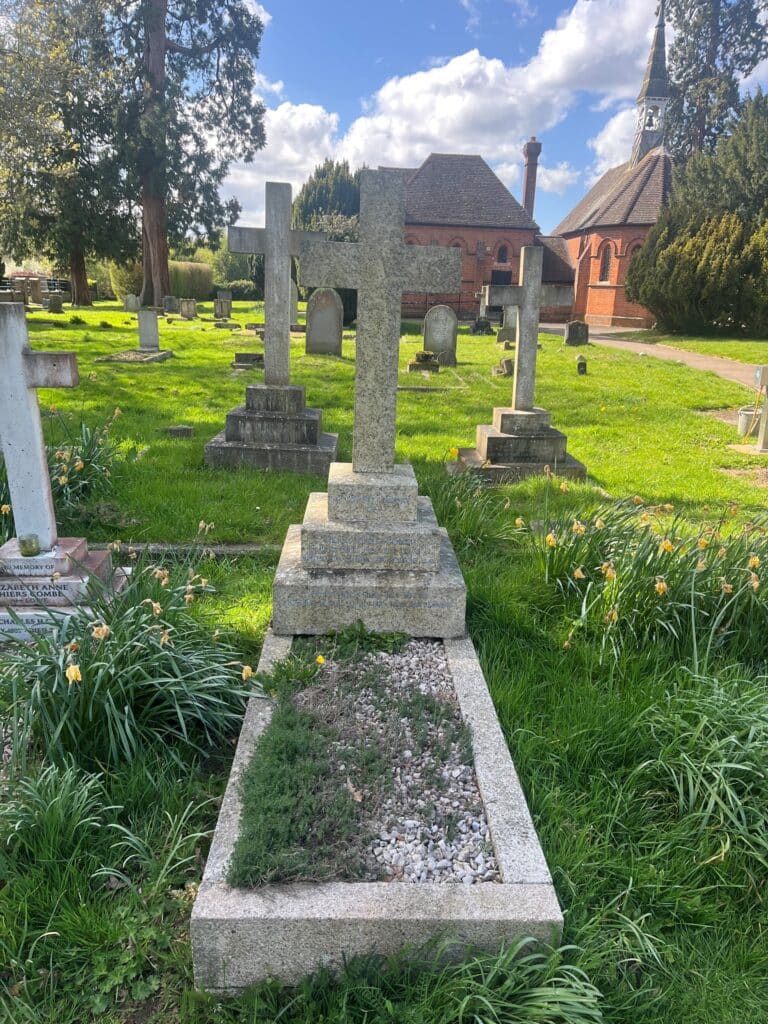
Ethel’s grave at Cobham Cemetery. It reads: In loving memory of Alice Ethel Combe who died Oct. 8th 1942. Widow of Charles Combe, J.P. Everything that has loved and has loved to the end will meet again.
Ethel’s obituary praised her legacy at Painshill and her work to support the local schools and village. She was buried in Cobham Cemetery. Engraved upon her headstone are the words ‘Everything that has loved and has loved to the end will meet again.’ Alone, this saying appears to be a beautiful sentiment about meeting loved ones in the afterlife. However, this phrase was the second half of a longer one by Giuseppe Mazzini, a revolutionary who fought for Italian unification. The first half of the saying can be found on Charles Combe’s grave: ‘There is no death in the world except forgetfulness.’ The two halves of this speech unite the couple in death and remind us that if we remember loved ones, their legacy never dies.
In telling their story – the good and the bad – we can give Ethel and Charles the immortality that they longed for. Ethel’s story has never before been told in its entirety. This has looked to give her a voice and offer an insight into the life and mind of a vibrant, strong, innovative, and complex figure.
Sources
Taylor, D. (2006). An Estate for All Seasons. Phillimore & Co.
Arnold, M. and Lang, C.Y. (2001). The Letters of Matthew Arnold: 1879-1884. University of Virginia Press.