THE GARDENER’S COTTAGE AND THE WALLED GARDENS
By Georgia Wilkinson
Narrated by Nicola Barranger
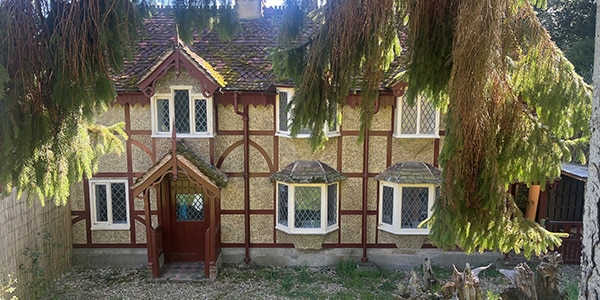
As you walk over the bridge into Painshill, the first thing you see is the Walled Gardens. It greets you with its high brick walls standing resolutely over the Mole River. You may have popped your head in once or twice, admiring the seasonal vegetables. Or perhaps you like to sit and read in the gentle tranquillity. As you stroll towards the Visitor Hub, you might notice an old cottage on your left. It’s two storeys high, with a steep sloping roof and decorative timber beams painted a deep reddish-brown. This is the Gardener’s Cottage. Today, it serves as a space for Painshill volunteers to relax between shifts, but its history is long, varied, and intertwined with the story of the Walled Gardens.
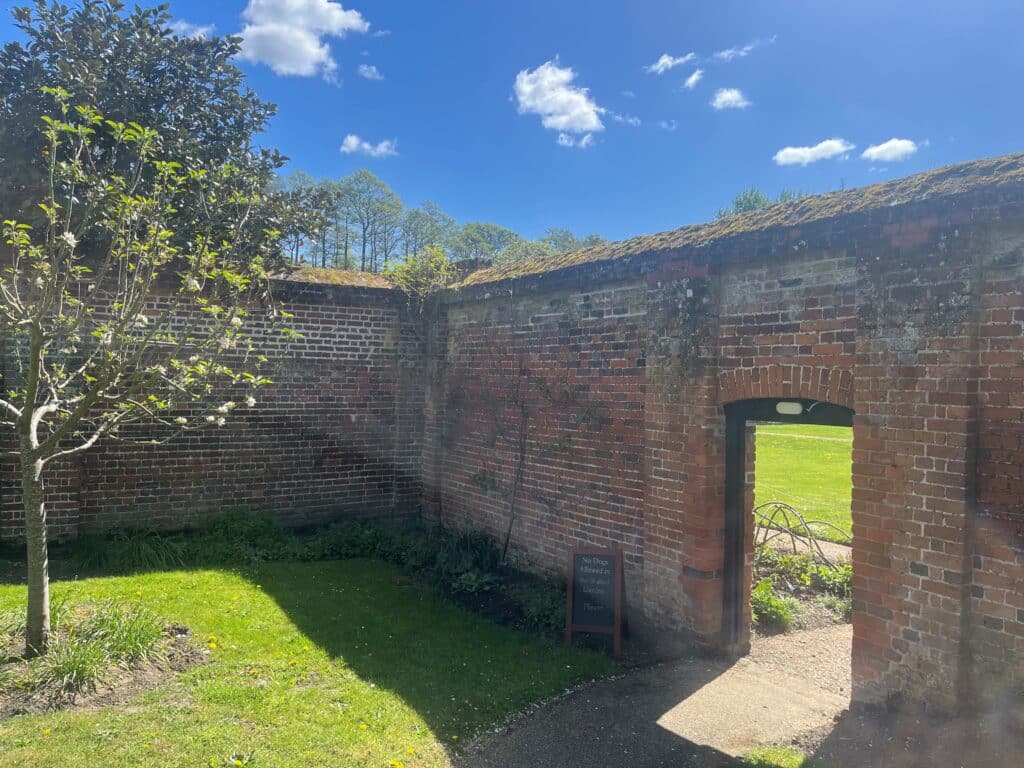
The entrance to the middle section of the Walled Gardens. Today, this section is used to host special events.
BEHIND THE WALLED GARDENS
The Walled Gardens at Painshill consist of three conjoined sections. From an aerial view, they look like steps hugging the river’s edge. The section nearest the Visitor Hub is now home to the Kitchen Gardens. Anyone can visit this and see the colourful vegetables destined for the Tea Room. The next section houses a large, manicured lawn where weddings and other special events are hosted. Finally, the last section serves as the maintenance depot and is not currently visible to guests. These spaces have been repurposed to meet Painshill’s 21st century needs, yet all three sections were originally constructed to grow fresh fruit and vegetables for the park’s owner.
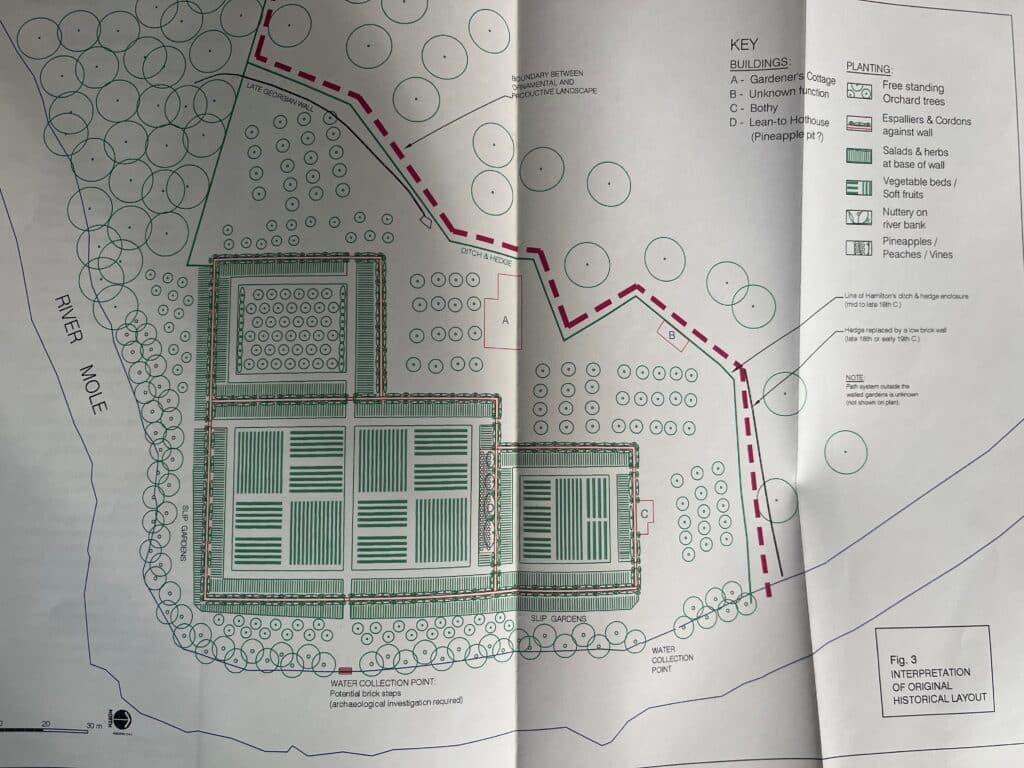
This map from the archive room depicts the historical layout of the Walled Gardens. Section A showcases the positioning of the Gardener’s Cottage.
The Walled Gardens were built by Charles Hamilton in 1756. Hamilton had developed a friendship with a botanist called Abbe Nolin. In the mid-18th century, Nolin was held in high regard by the aristocrats and royals of Europe and beyond. Most notably, he served as Garden Advisor to two French Kings: Louis XV and Louis XVI. One can imagine Marie Antoinette roaming the grounds of Versailles, passing a myriad of plants curated by Nolin. For Hamilton, this was an incredible contact, and the pair exchanged numerous letters, seeds, and gardening tips. Nolin sent Hamilton exotic American shrubs and plants, fruit trees, and an entire manuscript regarding the cultivation of peach trees.
The three gardens required substantial attention and by 1769, Hamilton had hired a Head Gardener who oversaw a team of 7. It’s challenging to piece together what the life of Painshill’s Head Gardener would have looked like in the mid-18th century. Few remnants survive. However, in the later Georgian period, a house was certainly provided. In the quiet rooms and quaint private garden of the cottage, we can begin to piece together the lives of Painshill’s gardeners.
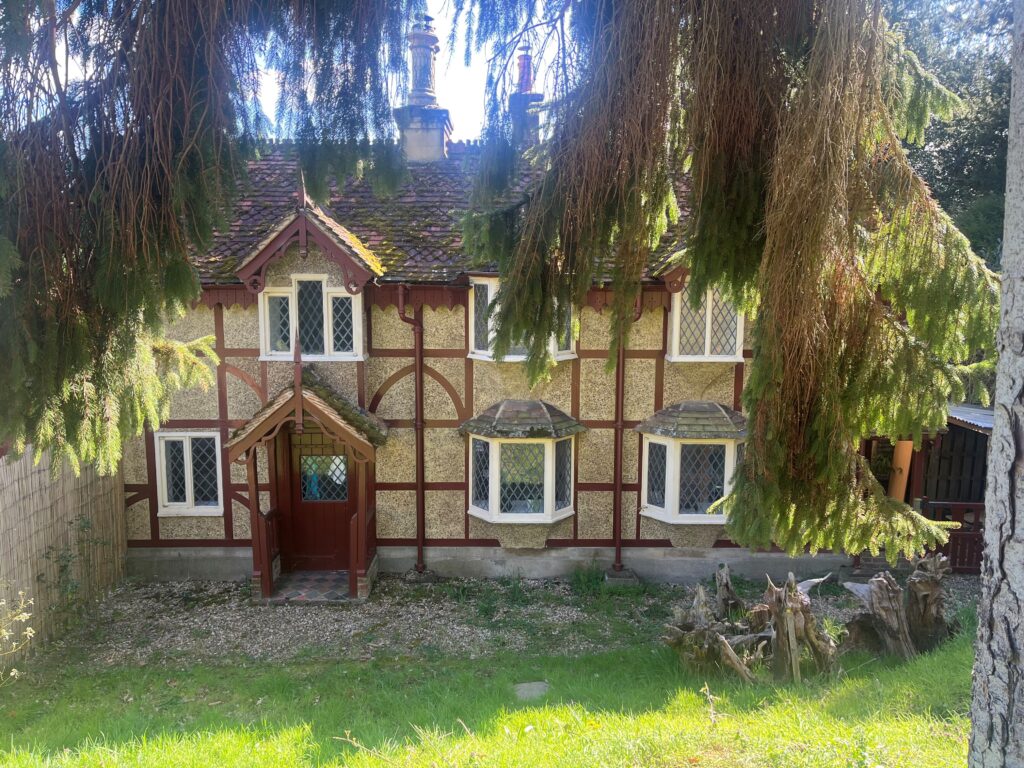
A view of the Gardener’s Cottage.
INSIDE THE GARDENER’S COTTAGE
In Hamilton’s day, a fruiting house would have stood on the site of the current cottage. This would have been used to cultivate and display exotic fruits and plants. Years after Hamilton’s ownership, a gentleman named William Henry Cooper bought Painshill. During the 1830s, Cooper constructed a cottage to house the Head Gardener and his family. It was designed in a Tudor Revival style with a glass lean-to. Inside was a vinery that grew juicy Black Hamburg grapes – a delicate nod to Hamilton’s original vineyard. Unfortunately, the glass vinery no longer survives but the cottage still stands. Remnants of the boundary wall, suggestive of a larger cottage garden, can still be seen near the staff car park.
The narrow cottage entrance and kitchen transport you back to the mid-19th century. Not because of the décor – that has been modernised at various points over the last 200 years to suit the tastes of the residing gardeners – but because of the incredibly low ceiling height. It serves as a reminder of our shorter statures during the peak of the Industrial Revolution.
In 1984, an early 20th century resident of Painshill gave an account of his youth in the cottage. The 83-year-old Mr Hicks had been the son of the Head Gardener. His mother had given birth to him in one of the upstairs bedrooms in 1901. He continued to live there until he was 28 years old. He recalled how his father would tend to the Walled Gardens and how they would irrigate the gardens with a river pump and a two-wheeled tank. This was later replaced with hydrants and an engine house.
Hicks also revealed that when he was young, 3 cedars and a mulberry tree had been planted around the cottage. In 1929, Hicks left Painshill and the cottage became affectionately known as ‘Lunn’s Cottage’ after the new residents, Harvey and Louisa Lunn. The Lunn’s turned the walled sections into a market garden, cultivating produce for local sale. Once again, the adaptation of the cottage and the innovation of the Walled Garden were tied.
The Gardener’s Cottage has changed hands many times since the Late Georgian period. It has served as a home to the people who have overseen the physical transformation of Painshill; the people who have cared for the plants and given the landscape new life again and again. These structures are as much a part of Painshill’s legacy as any of the follies and while they may not be as grand or magnificent, they possess a humble, tranquil beauty.