By Georgia Wilkinson
Narrated by Nicola Barranger
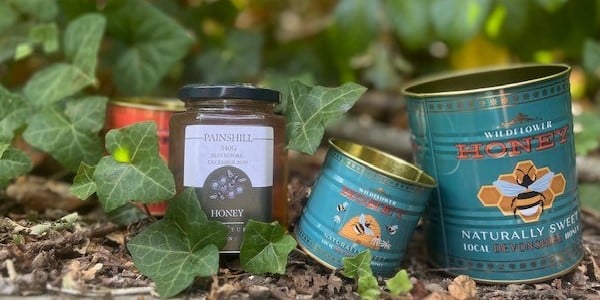
We have recently welcomed back one of Painshill’s most popular products: delightfully sweet, golden honey produced by our very own bees. Neither the bees nor the honey are new to Painshill. I recently had the opportunity to speak to one of Painshill’s current beekeepers: Marion Cooper. Marion and her husband Geoff have been caring for the bees at Painshill for thirty years. In that time, they have seen vast changes to the landscape and the very nature of beekeeping. It’s more challenging now than it used to be; the bees require more attention and protection from the ecological changes of the modern world. Habitat loss, the arrival of new pests and diseases, and environmental contamination significantly impact bee welfare and make the work of beekeepers like Geoff and Marion more essential than ever.
Geoff and Marion use their expert knowledge to monitor the health and behaviour of our bee colonies; they also ensure that adequate food stores are available. This is particularly important when harsh weather conditions make it impossible for the bees to forage for themselves. The honey at Painshill has a deliciously complex taste and colour that changes with the seasons. This is due to the fabulous variety of flowers and trees. The bees collect nectar and pollen from all of these plants, as well as Painshill’s unique vineyard. They transport the nectar back to their comb and begin the process of converting it into honey. They inject the nectar with enzymes and flap their wings vigorously until the water content has reduced to less than 20%. At this point, the bees secure the honey with a wax seal, ready for collection!
Recently, I saw Geoff and Marion at work. An unusual bee swarm was reported on Grotto Island near the Chinese Bridge. Bee swarms typically occur when a hive has become overcrowded and a section of the population splits off to start a new one. Curiously, these bees had swarmed on the ground rather than a bush or tree. After inspection, Marion and Geoff discovered that the bees were not part of Painshill’s hive but that they needed rescuing. The reason the bees had formed a ground swarm was likely due to an injured queen and if the queen couldn’t move, neither would the two thousand other bees. Our beekeepers raced to Painshill to start the rescue mission. Soon, I found myself wearing a full beekeeping suit alongside Marion and Geoff. Due to the unconventional nature of the swarm, we were lucky to have the combined knowledge and experience of the couple. They set a cardboard box on top of the bees (the reverse of usual procedures) propped up with twigs. The bees were very calm and slowly made their way into the box with a little help from Geoff’s hive smoker. When the bees were ready, a sheet was slid underneath the box and the bees were bundled up, ready to be taken to their new home. Geoff and Marion managed to rescue almost all of the approximately two thousand bees. It was an incredible experience that demonstrated the care and innovation required of dedicated beekeepers.
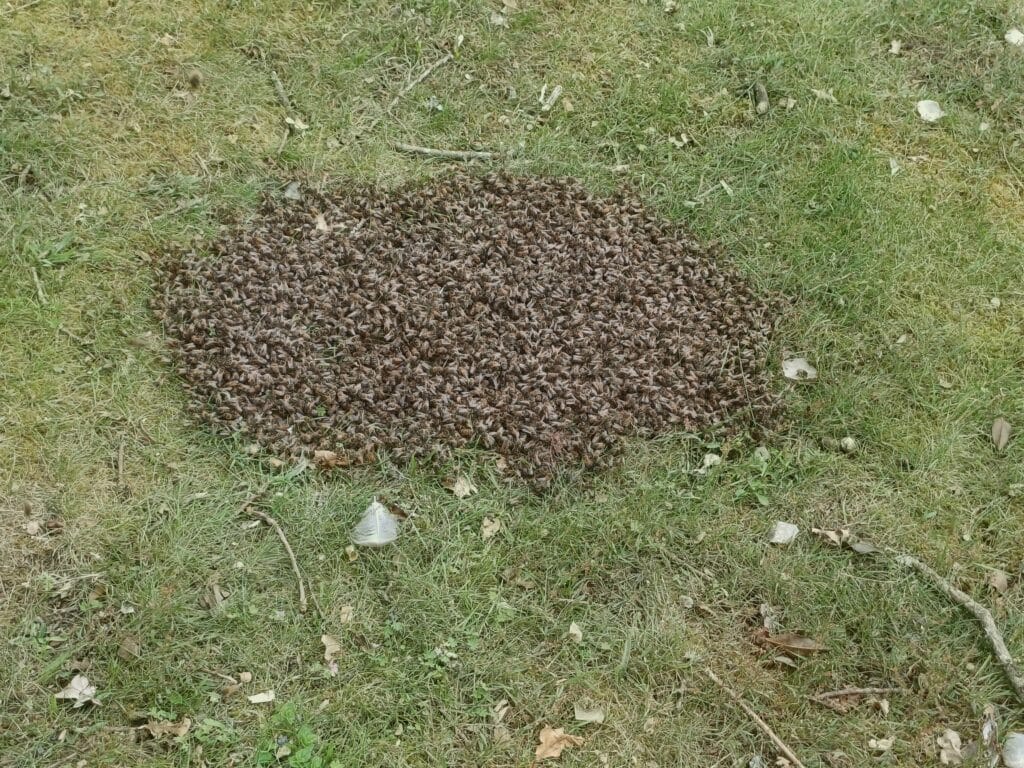
The bee swarm on grotto island
Although Geoff and Marion have been caring for the bees since the mid-nineties, the history of beekeeping at Painshill stretches even further back. Marion kindly shared an article that she’s preserved from July 1986. The paper has yellowed over time, but there is a clear picture of Joan Harborne smiling through the mesh netting of her beekeeping headwear. Before the apiary was set up on Painshill Park land, Joan looked after bees at the neighbouring Belfry House. The apiary there had been built by owner Leslie Coldwell, who eventually entrusted the beekeeping to Joan. The article reported that the bees foraged on the acacia and lime trees growing at Painshill. At the time, Painshill visitors drove through what is now the staff entrance and were greeted by volunteers at two huts. One sold tickets, the other sold Painshill’s delicious honey.
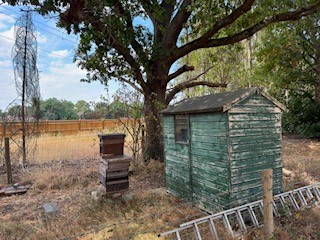
The beehives at Painshill
It seemed Joan enjoyed sharing the secrets of her trade. She advised that the biggest mistake when caring for bees is fear. Fear, Joan believed, leads to sweat, and sweat makes the bees more likely to sting. Whether or not this theory was scientific, it seemed to work for Joan, who would regularly place her bare hands into the hive. Joan also revealed that the reason beekeepers puff smoke over their hives is to stop the bees from stinging. The bees assume the smoke is a forest fire, which encourages them to eat as much as they can before their supplies burn. Like all of us, once the bees have a full stomach, they become happy and calm, and much less likely to sting.
Eventually, the apiary was passed on from Joan Harborne to Peter Hartt and finally to Marion and Geoff. For the first time, the bees and their apiary were moved onto Painshill’s land; it still stands today on the edge of Painshill’s northern boundary, up the slope and beyond the Keyhole Plantation. Marion and Geoff have looked after the bees at this spot for thirty years, providing fabulously tasty honey for our shop. At the end of this year, they intend to pass the hives on to another experienced beekeeper.
A well-deserved retirement indeed.