By Georgia Wilkinson
Narrated by Nicola Barranger
Real-life Rapunzels and knocks in the night. Meet the people who called the Gothic Tower home.
The Gothic Tower is a visitor favourite at Painshill. It’s an impressive 27-metre-high structure, with 99 steps leading to the roof. Visitors can find it at the far end of the landscape; its turret peeks out of the woods, evoking an image from a fairytale. It’s easy to assume that this folly was all for show – and when Hamilton built it, it almost certainly was – but as Painshill moved into the 20th century, the Tower became a home for Painshill’s workers and their families.
Visitors are always surprised and delighted to discover that real people once lived in the Gothic Tower: babies were born, children would play, tears were shed, and special moments were celebrated. The Tower has seen all of life’s ups and downs, and its rooms have been repurposed to suit different needs.
We’re about to meet two sets of residents who both called the Tower home. First, the Stevens family, whose large brood of girls were the ‘real-life Rapunzels’ of the early 20th century. 90 years later, woodland manager and shepherd, Jon Ireland, moved into the Tower. He has kindly shared his experiences about life in the Tower during the early 2000s.
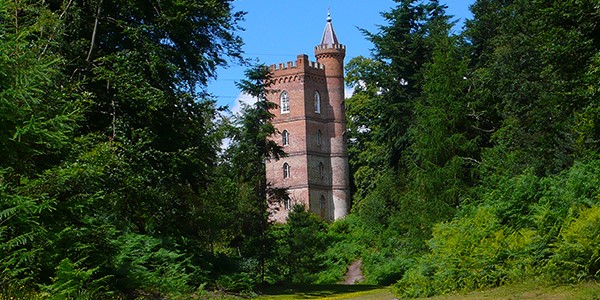
The Gothic Tower in the 21st century. Photographed by Fred Holmes.
Real-Life Rapunzels
The Stevens family moved into the Gothic Tower in 1909. 26-year-old Thomas had been employed by Charles and Ethel Combe as Painshill’s woodman. He and his family were likely the first to be provided with accommodation in the Gothic Tower. Thomas brought his wife Mary (aged 32), and their daughters: 5-year-old Winifred and 3-year-old Gladys.
To prepare the Tower for the Stevens family, the Combes had a kitchen built onto the ground floor next to a sitting room. The family had access to an external toilet and soon, a water storage tank. The upper three floors were bedrooms. Thomas, Mary and eventually their younger girls slept on the first floor; their older daughters slept on the second, and two lodgers had the top floor. The lodgers were a fellow woodman and a carter (someone employed to transport goods).
Between 1910 and 1915, the Stevens family continued to expand. Mary gave birth to three more daughters: Mabel, Kathleen, and Elsie. For the first few years of their life, the girls didn’t know much of the world beyond the Tower and when they returned to Painshill in the 1980s, the memories they recalled could’ve been from a fairytale.
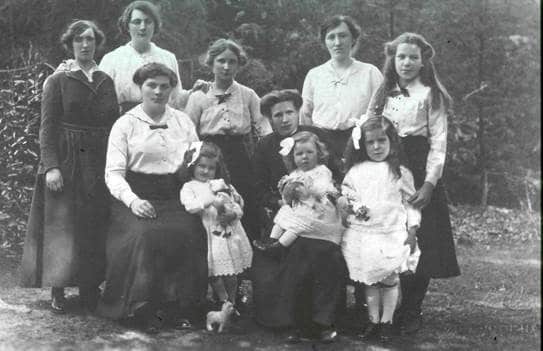
Mary Stevens, her daughters, and some of their relatives.
One of the older girls remembered her classmates teasing her that the Tower was haunted. Despite her mother promising her that it wasn’t, the stories upset the little girl and she would have nightmares of a hairy monkey-like beast watching her from the landing.
On another occasion, in 1916, one of the girls dropped her ribbon out of the Tower’s top window. Perhaps it was an accident, or perhaps she had wanted to watch it float to the ground, but unfortunately the ribbon caught on the ledge below. The girl was terrified that her mother would tell her off for losing the ribbon, so she dangled her little sister out the window by her ankles. Luckily, the younger girl managed to grab hold of the ribbon without falling, and her sister pulled her back to safety; their mother none the wiser.
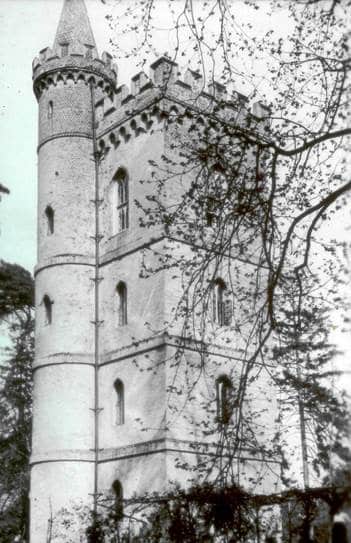
The Gothic Tower in the early 1900s.
On Sundays, the sisters would wander down to the Grotto. When they set off, their mother would remind them not to pick flowers, but one bright Spring day, they just couldn’t resist. As they continued on their walk, clutching handfuls of bluebells, they spotted Charles and Ethel Combe coming towards them. The girls tried to hide the flowers, thinking they would be in trouble, but Ethel only laughed and reassured them that they could pick the bluebells if they liked.
Tragically, the outbreak of the First World War ripped the Stevens’ fairytale apart. Thomas was enlisted in the army and sent off to fight in Europe. Now, instead of staring at the stars, his daughters would watch the zeppelins from the Tower’s roof.
Thomas died in action on the 23rd of August 1917. He was only 34 years old. Mary stayed with her daughters in the Tower for several months until early 1918, when she and the girls had to make way for the new woodman. That winter, she moved her five girls to a small cottage in Crawley. The Stevens girls had known no other home than the Tower. Kathleen recalled being utterly shocked by the normality of living in a regular house. She had just assumed that everyone lived in towers.
The Shepherd in the Tower
90 years after the Stevens family moved in, another Painshill employee would call the Gothic Tower home. Jon Ireland lived in the Gothic Tower from 1999 to 2005. After completing a Practical Habitat Management course in Guildford, Jon was taken on as a woodland manager and shepherd at Painshill.
The Tower was quite different when Jon moved in. In 1973, a terrible fire had gutted the inside. The Tower was restored and reopened in 1989, but the layout was split between accommodating both visitors and live-in staff. The downstairs was fitted with visitor bathrooms and the top floor was transformed into an exhibition space. Jon lived between the first floor, which served as his kitchen and living room, and the second floor, which housed his bedroom and bathroom. On weekends, to keep his living spaces private, he kept the doors tightly locked. He recalled that most weekends he was interrupted by someone mistakenly rattling the doorknob and muttering when they couldn’t get inside.
At night, when Painshill was empty, Jon found it a little spooky living alone in the Tower. Sometimes, he would hear heavy thuds on the door. Jon, being more relaxed than most people, would just ignore it and go back to sleep. Not all of Jon’s guests were quite as easy going. His brother would never stay because he found it too spooky after dark.
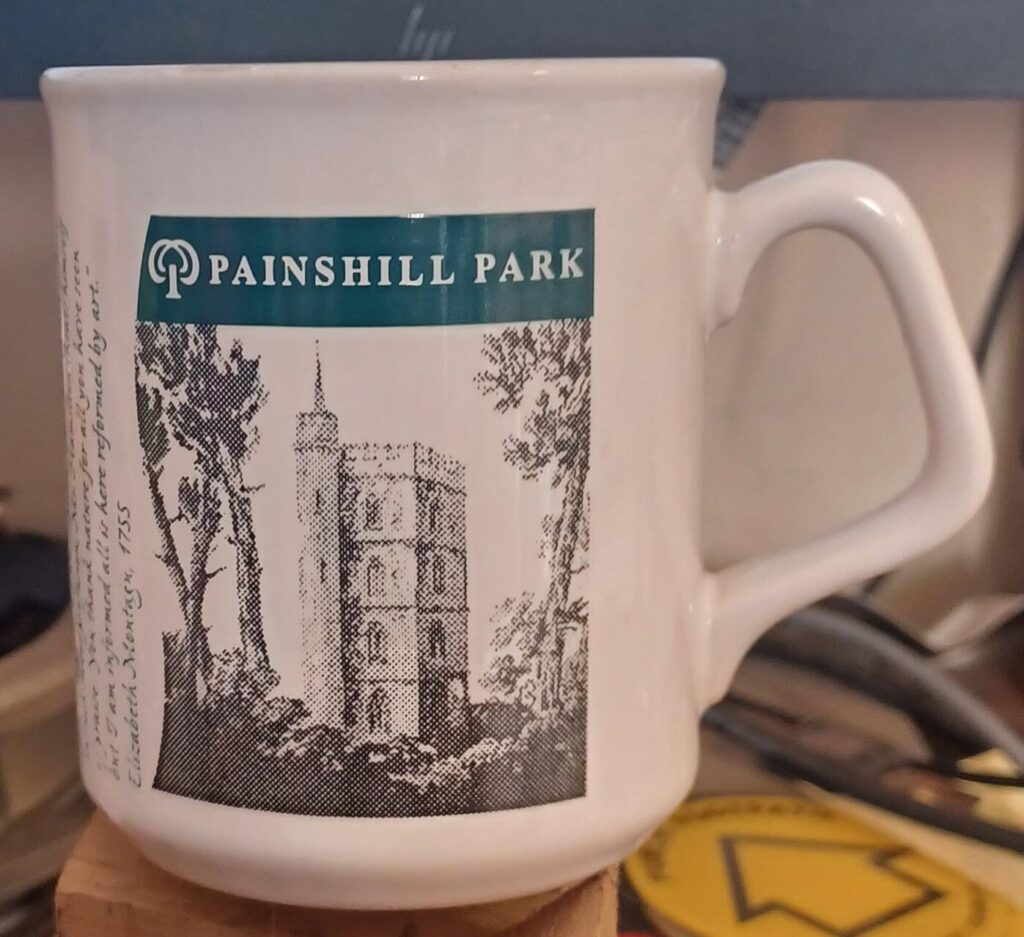
Jon Ireland’s mug, reminding him of his time at Painshill.
The trouble was that Jon was becoming too accustomed to sleeping through noise. On one side, he had the noisy A3, on the other, the chirping of the woodlands. On one occasion, a bug crawled inside the fire alarm, setting it off during a loud thunderstorm. Impressively, Jon managed to sleep through this, but he was eventually woken by firemen, who weren’t particularly pleased with him. The solution was to install a bug zapper that emitted a strange blue light. Jon remembers walking back to the Tower from the pub one evening and seeing the ghostly blue light emanating from the windows. He thought it looked like “Frankenstein’s castle” peeking out from the trees.
Jon has a few favourite memories about his time in the Tower. A particularly special occasion was celebrating his friend’s 40th birthday on the roof. Jon also reminisces about building the Hermitage. It was Jon who discovered the foundations of the Hermitage with a digger in the early 2000s. At that point, it was debated as to whether there had ever been a real hermitage at Painshill. After his discovery, Jon helped to rebuild it for future visitors to enjoy.
For Jon, his time at Painshill was a completely transformative period of his life. After living in the isolated Tower, Jon became very good at DIY and by the time he was ready to move on, he could fix just about anything. Nowadays, Jon works as a Lead Ranger for the National Trust, and he remains as passionate about animals, nature, and history as ever before. At Painshill, the lasting impact of Jon’s hard work and dedication can still be seen across the landscape.
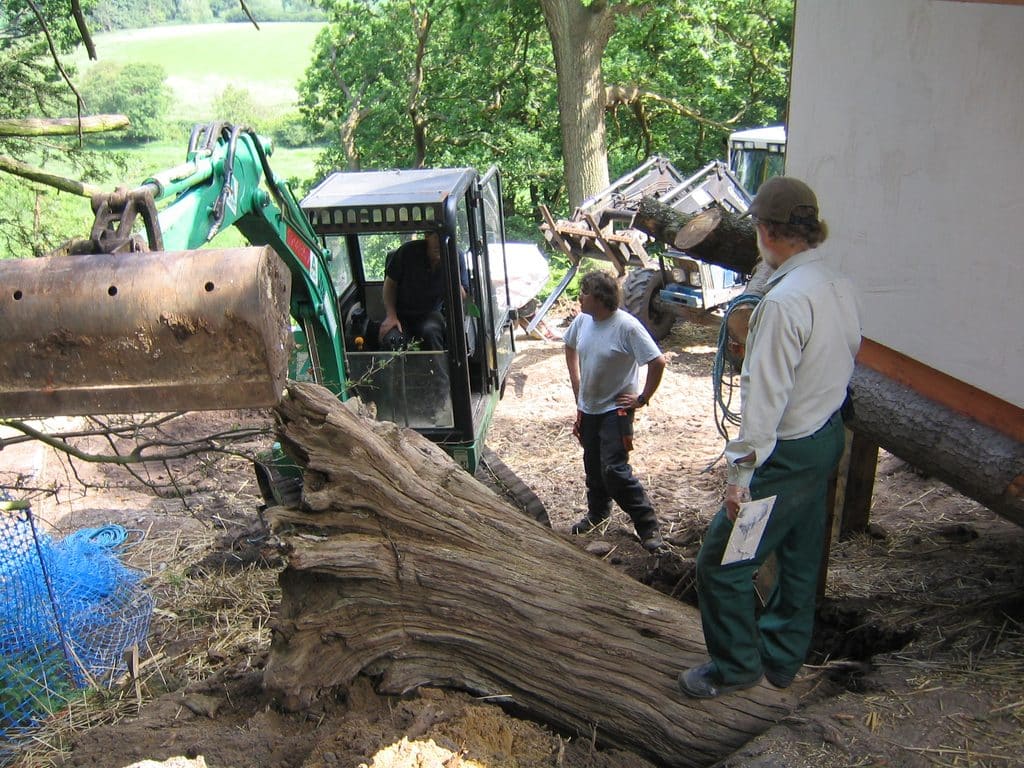
Jon Ireland helping to rebuild the Hermitage.
The Memory Tower
The Gothic Tower has stood at Painshill since the 1750s. It has been a folly, an architectural interest, and a home. Its walls are full of memories and it continues to be an enduring symbol of Painshill’s history and the people who have helped preserve it.
The Gothic Tower now serves as a tea room during summer, and can be booked as an exciting venue for meetings.
Acknowledgements
Mavis Collier
Jon Ireland
Cherrill Sands
Andy Townsend