RUMOURS OF A ROCKERY
By Georgia Wilkinson
Narrated By Nicola Barranger
History can be a little rocky…Find out how Painshill was affected by the Edwardian rockery craze.
The rockery is one of Painshill’s best-kept secrets. If you search for it today, you’ll find essentially no trace of it within the park’s vast landscape. In the archive rooms, you could scan documents for hours and find no more than a passing mention of it. The search becomes even more complicated when you factor in the various names that it has gone by. Rumours of ‘a rockery’, ‘a rock garden, ‘rustic steps’, and ‘rockery steps’ have all been used to describe this mysterious feature at Painshill.
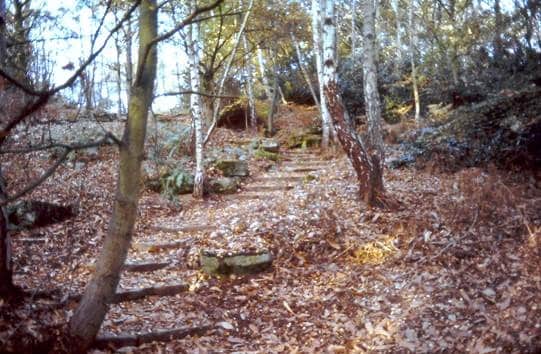
Painshill’s rockery in 1982.
What exactly is a rockery?
The history of rockeries can be traced back to ancient East Asia. Chinese and Japanese gardens implemented rocks for decorative, philosophical, and spiritual purposes. English rockeries were typically created to showcase alpine plants and create the illusion of mountainous environments. The first is often cited to be The Pond Rockery at Chelsea Physic Garden. It was built in 1773 but was considerably ahead of its time as rockeries didn’t gain popularity until the 1830s. In the Victorian and Edwardian periods, rockeries sprang up everywhere. There was such a significant boom in demand that companies such as Pulham & Son became famed for installing entire rock gardens. The craze was so prominent that innovation was needed. Pulham & Son developed a type of artificial rock that became known as pulhamite. This offered durability at a lower cost. Some clients, however, didn’t want to pay a penny and found alternative means of acquiring rocks – Painshill’s Edwardian owners were no exception.
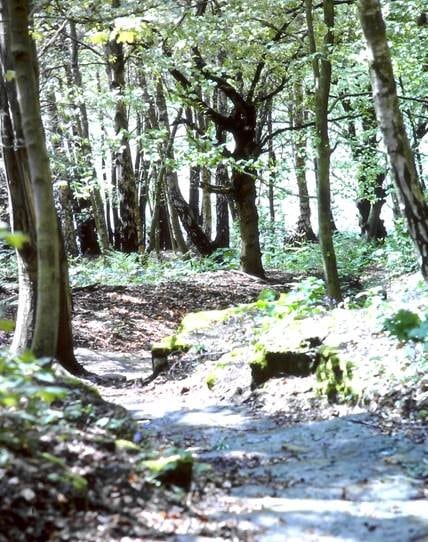
The rockery in June 1983.
The Vineyard Era
Painshill’s rockery had a unique journey. When Charles Hamilton was creating his landscape here in the 18th century, rockeries were not yet in fashion. On the north side of the lake, he had a large slope with south-facing views. In a rather ambitious undertaking – and certainly one of the first to be attempted on English soil – Hamilton established a vineyard. He planted the vines between 1740 and 1743 with just two burgundy grapes – an Auvernat (Pinot Noir) and a Miller Grape (Pinot Meunier).
After enduring a few challenging years, Hamilton realised he needed an experienced vigneron for the vineyard to be successful, and so he hired Frenchman David Geneste. Geneste had all the right credentials – he grew up on an ancestral vineyard – and yet it appears he didn’t know quite as much about the business as Hamilton thought. Geneste would frequently write to his sister, Marie Broderie, for help. She had inherited the family vineyard and was considerably more knowledgeable than her brother. With the information and equipment that she provided, the vineyard produced several successful wine varieties.
In 1773, Hamilton sold Painshill to Benjamin Bond Hopkins, who ensured that the vineyard was maintained in good condition. No wine was produced during Hopkins’s ownership, but he preserved the vineyard for its aesthetic value. When he died in 1794, the vineyard was swiftly neglected. Utilitarian attitudes of the early 19th century had replaced the whimsical frivolity of Hamilton’s era and by 1834, the slope was covered in Scotch pines.
The vineyard was nothing but a memory.
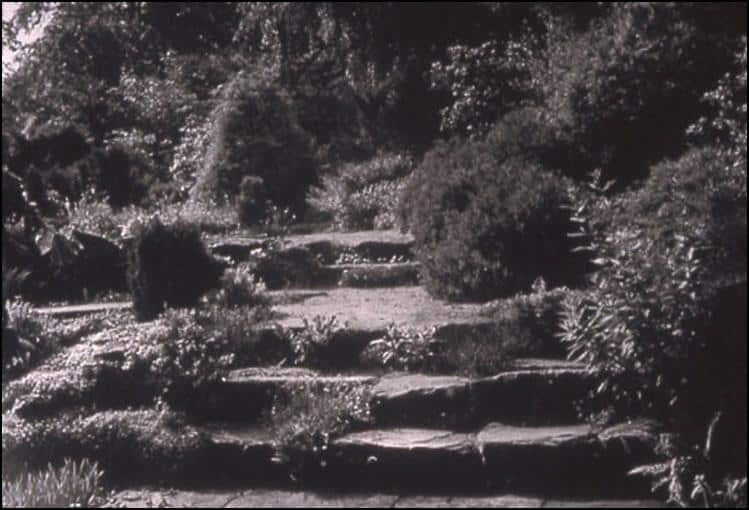
The rockery in the 1930s.
The Edwardian Rockery
The rockery was the creation of the beautiful Ethel Combe. Ethel took over Painshill after the death of her husband, Alexander Cushney. Cushney had been four decades older than his wife, and so when he passed away in 1903, Ethel remarried. Her second husband was Charles Combe. His family owned the Cobham Park Estate, but Ethel’s heart remained at Painshill. She insisted that her new husband join her, and together they adapted Painshill to suit Edwardian tastes. Rockeries were incredibly en vogue, and Ethel decided that she must have one. Presumably to avoid extortionate costs, the couple decided to take the rocks from Hamilton’s original Cascade and move them to the neglected vineyard. By 1907, they had their very own rockery.
The old vineyard was the perfect spot. Its high slope and south-facing orientation offered the ideal elevation and sunlight for alpine plants to thrive. From the top of the slope, the Cascade rocks were used to create steps that led the visitor downwards, forking at intervals and allowing the plants to be admired against the backdrop of the sparkling lake. Photographs from the 1930s depict the rockery in good condition. It likely remained so until 1939, when Painshill was requisitioned to support the war effort and the landscape was neglected.
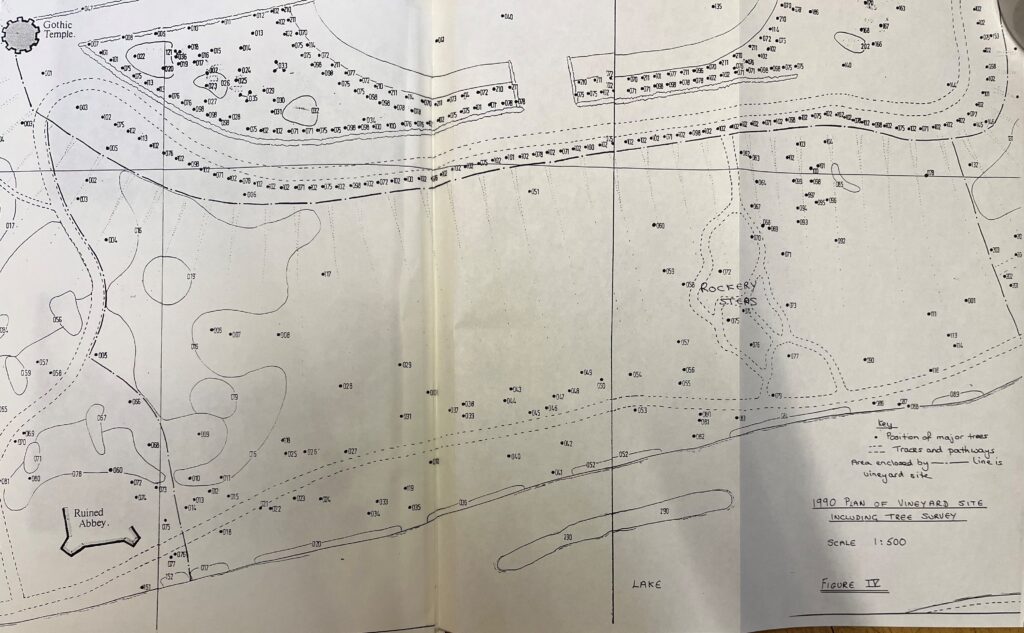
A plan of the rockery drawn in 1990.
Archaeologists in the 1980s wanted to restore Painshill to Hamilton’s original vision. And so, even though the rockery had largely survived, plans were made to clear the trees and plants, remove the rock steps, and replant the vineyard. Clearance began in December 1990, and by the end of January, the rocks had been removed for £220 and were inspected by an archivist for a further £150.
In Spring 1992, the vineyard was restored and has remained an essential part of Painshill’s legacy ever since. The vineyard was a key feature of Hamilton’s vision and a unique chapter in English winemaking history, but it is unfortunate that a surviving Edwardian rockery became collateral damage in the restoration endeavour. Due to the lack of interest in the rockery in the late 20th century very little information about it survives. Although the rockery no longer exists, the pieces that made it have been moved back to the Cascade, where they can still be seen today.
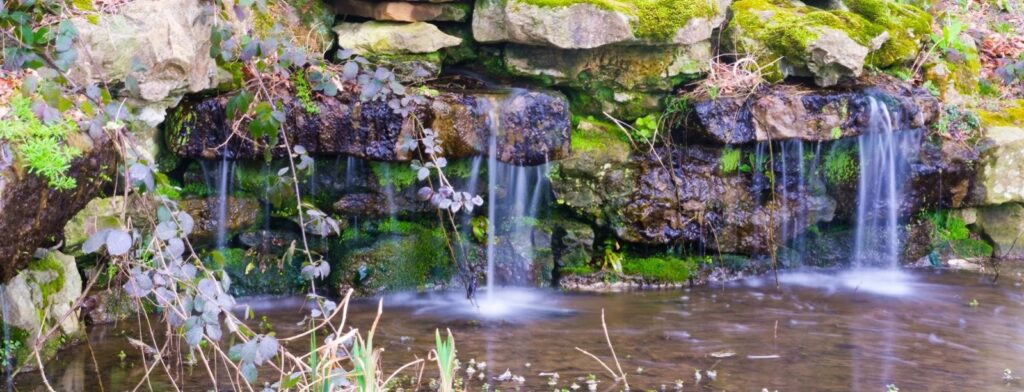
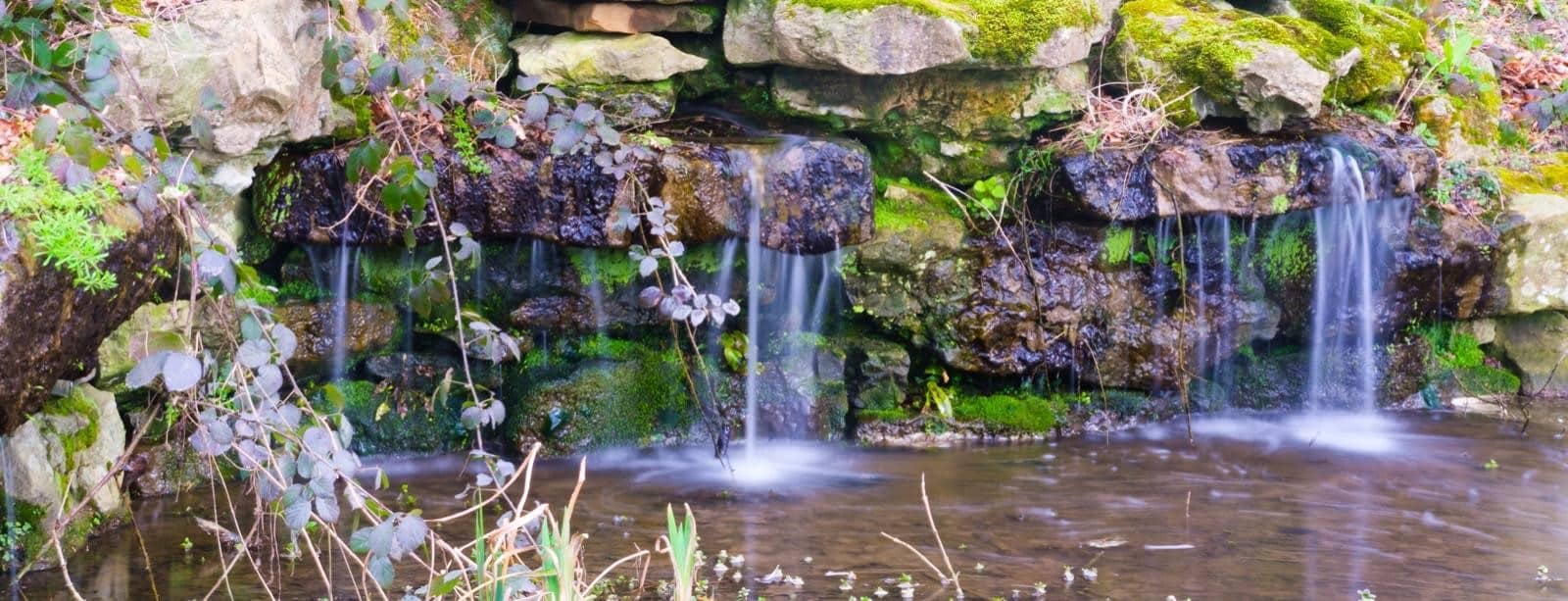
The rocks were taken from the rockery to rebuild Hamilton’s Cascade in the 1990s.