THE ‘PATCHWORK’ WINE GOD
By Georgia Wilkinson
Narrated by Nicola Barranger
Introducing Painshill’s Statue of Bacchus…
When Charles Hamilton created Painshill, he was famously inspired by his Grand Tours across Europe. On his travels, he absorbed the history and mythology of ancient cultures and sought to recreate elements of this in England. Painshill’s follies and features reflect Hamilton’s fascination with the classical world, but there was one mythical figure that Hamilton grew particularly fond of.
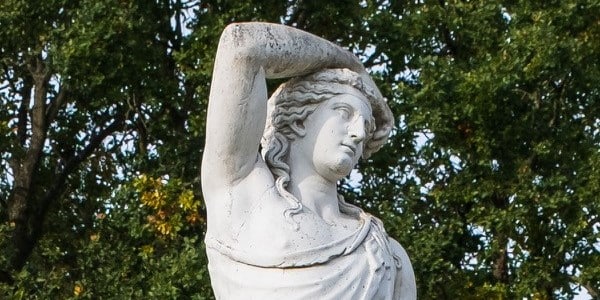
Just beyond the Walled Garden, Painshill’s visitors are greeted by a large statue of a Roman god. He stands proudly, with one hand angled behind his head and the other clasping grapes. Apart from the scrap of fabric draped over his chest, he is completely nude. This is Bacchus, the God of Wine – a rather apt protector for Painshill and its beautiful vineyard. However, Bacchus has a secret: he is a ‘patchwork’ statue, and a very expensive one too…
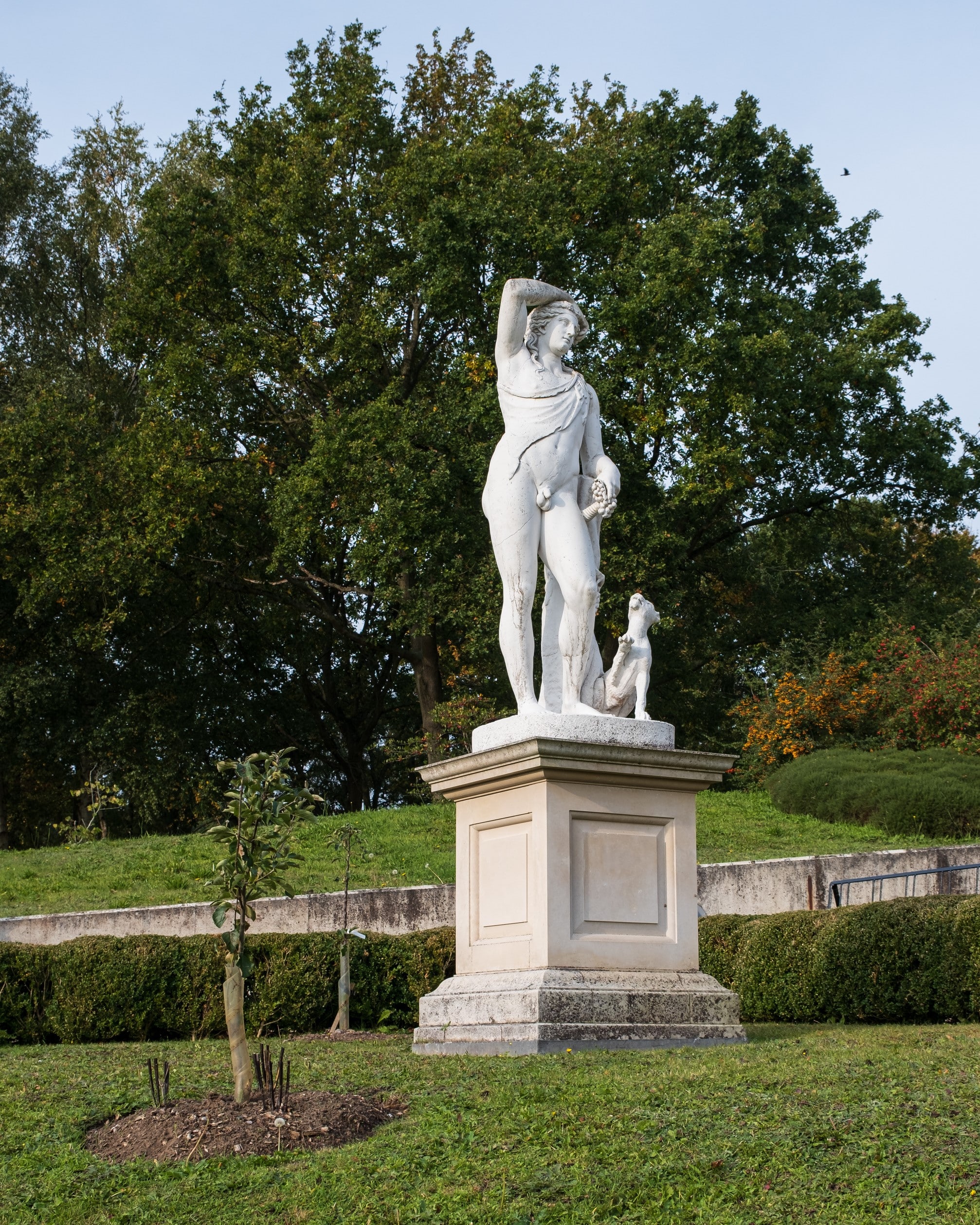
The Statue of Bacchus at Painshill.
A Very Expensive Statue
The statue was allegedly acquired by Hamilton in 1727 during a trip to Rome. Hamilton claimed to have purchased it from an aristocratic family for a hefty £2,000, which would equate to approximately £366,000 today. This was an extortionate amount of money for a statue that was a patchwork of multiple broken marbles stuck together. Hamilton’s Bacchus has the head of a Roman goddess placed onto a masculine body. The head and feet are certainly the oldest parts of the statue, and the only pieces that can confidently be called ‘ancient’. Even these, however, have likely been adapted. The sculptor who created this ‘Frankenstein-style’ piece likely made minor adjustments to masculinise the face. He would have thinned the lips and added stone to broaden the cheeks.
The torso was likely also the work of an 18th century sculptor. So is the doglike creature standing at the base. The feet of this animal suggest that it would’ve originally been a panther – Bacchus’ mythological companion – but the shrewd sculptor may have added doglike parts to appeal to English clientele. Dogs were popular companions in 18th century English portraits. In fact, in Hamilton’s 1732 portrait, he too is painted with dogs at his feet.
A Home for Bacchus
Whether or not Hamilton realised the true nature of what he had bought, he was happy with his wine god and built a temple to house him at Painshill. Bacchus lived in his temple until 1797, when he was sold at auction for £400 to an incredibly wealthy young man named William Beckford (Hamilton’s great-nephew). Beckford displayed the statue in the dining room of Fonthill Splendens. However, Beckford’s contemporaries had become aware that the statue comprised a patchwork of marble fragments. They wrote that they wouldn’t have paid half so much for it.
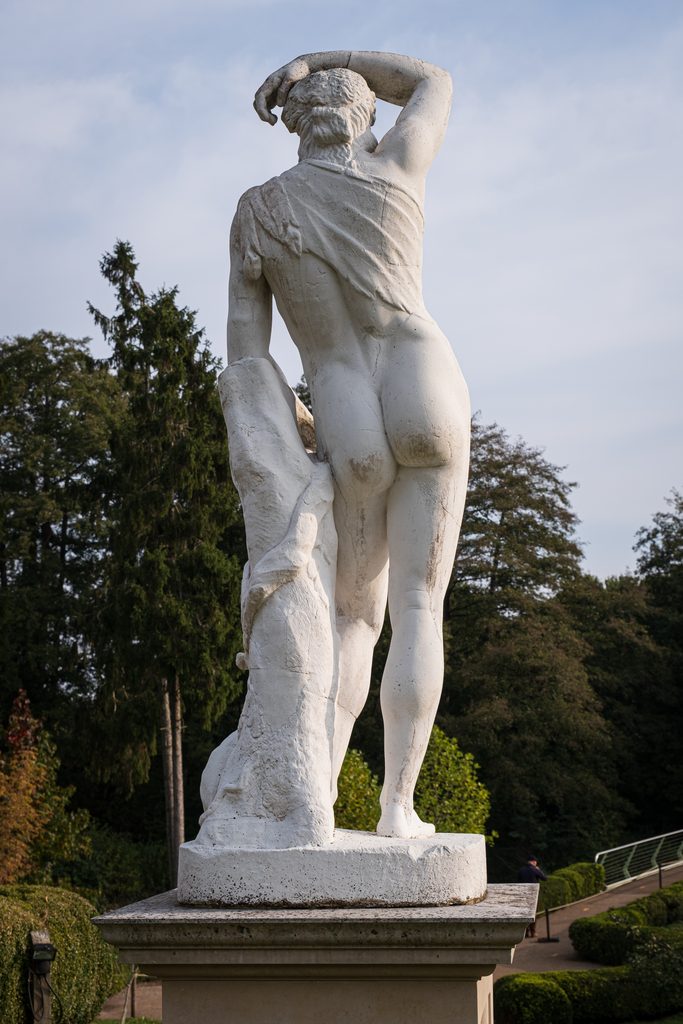
The back of the Bacchus Statue
The statue continued to depreciate.
Bacchus was sold a third time to a Mr Abbott in 1807; the price having reduced to 210 Guineas. Abbott was acquiring the piece on behalf of Thomas Johnes. Johnes (like Hamilton) had created his own landscape garden – the Hafod Estate in Wales. When the Hafod Estate was purchased by the Duke of Newcastle in 1832, Bacchus was eventually sent to London to be auctioned by Christie’s. The statue continued to change hands throughout the following century, and when he was sold again in 1928, it was for a disappointing £13. This is a far cry from his alleged original price.
Bacchus was purchased a year later by the 1st Baron Fairhaven. This final sale restored some of his value and saw him moved to Anglesey Abbey in Cambridgeshire, where he still lives today. In 2008, a cast copy was made for Painshill, which is proudly displayed by the Visitor Hub. Today, Bacchus embodies the vision and spirit with which Hamilton created Painshill: he brings a small pocket of classical beauty to the English countryside.
Acknowledgements
Cherrill Sands
Jan Clark