THE VANISHING STATUE
By Georgia Wilkinson
Narrated by Nicola Barranger
An ancient myth. A modern mystery.
The Statue
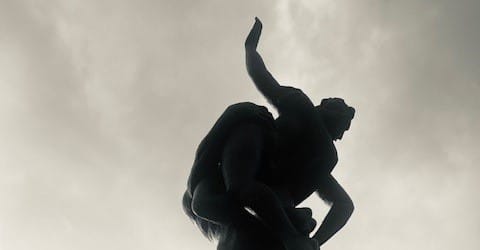
As the sun sets, light spills over a statue on the eastern boundary of Painshill’s Great Lawn. Shadows are cast over a tangle of bodies; three figures performing an ancient Roman myth. The figure at the base is a bearded older man crouching on the plinth. He throws one hand above his head in fear as a younger man overpowers him. A terrified young woman struggles in the arms of her muscled kidnapper. She represents the Sabine women; the young man is her Roman captor; the older man is her father. This scene portrays the foundation myth of Rome: The Abduction of the Sabine Women.
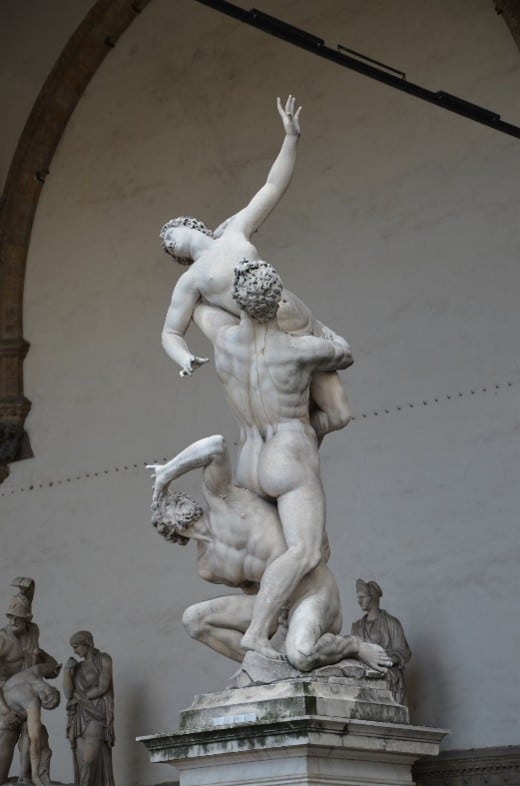
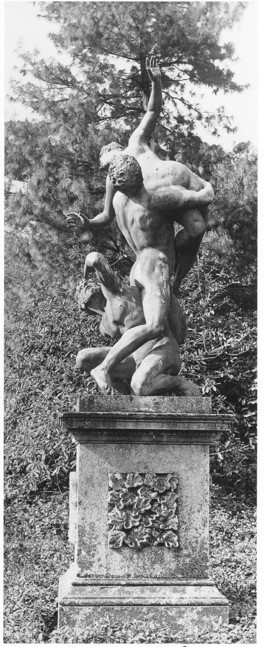
Hamilton’s statue was based on an original by Flemish sculptor Giambologna in Florence, around 1582. It is a masterpiece of 16th century mannerism – a style that adapted the symmetry and perfection of Renaissance techniques to create twisting, serpentine figures. The original model is currently housed in the Loggia dei Lanzi in Florence. Due to the popularity of the piece, casts were sold to buyers like Charles Hamilton in the early 1700s. John van Nost created a lead cast around 1710, and after he died, his workshop was purchased by John Cheere, who continued to manufacture these lead casts. Hamilton likely visited Cheere’s workshop to select and purchase the piece. He paid £25 for the Sabine Statue in 1763, which is a noticeable drop from the £90 Nost was quoting in the early 1700s. The price Hamilton paid is equivalent to approximately £4,400 today.
The Myth
According to the Ancient Romans, their city was founded by the mighty demigod Romulus. Romulus and his twin brother, Remus, were sons of the war god Mars and a Vestal Virgin named Rhea Silvia. As babies, the twin boys suckled the milk of a she-wolf and were raised by foster parents. As men, they raised an army and established the foundations of a city. However, the power balance between the brothers became uneasy. This unease grew into anger and mistrust, and eventually Romulus killed his brother, assuming sole control over his new civilisation: Rome.
However, Romulus’s problems were far from over. He had a city of soldiers; a city of only men. Without women, he knew that the civilisation he was building would die out within a generation, and so he led his men to abduct the local Sabine women. This incited a bloody conflict between the Romans and the Sabines, ending only when the women threw themselves between their Sabine fathers and their Roman husbands to stop the violence. This is the emotionally charged tale that the statue depicts.
The Mystery
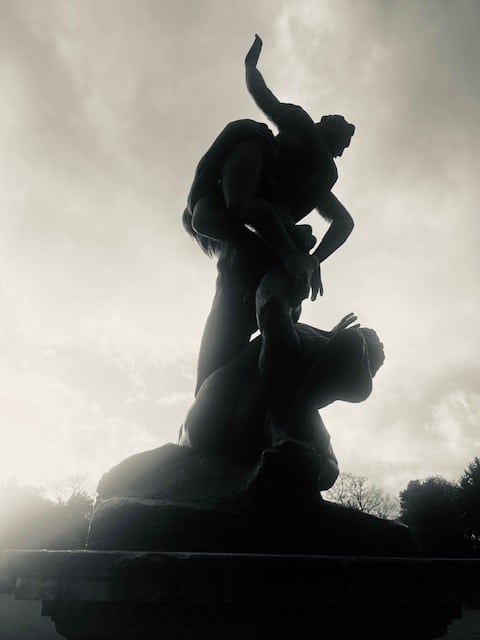
The history of Hamilton’s Sabine statue becomes shrouded during the Second World War. When Painshill was requisitioned for use by the Canadian Army, Painshill’s follies were badly neglected. In fact, there were several rumours as to the fate of this magnificent statue. Some believe that it was used for target practice by the Canadian Army when they carried out training on the Great Lawn. In all likelihood, the piece was melted down and sold for lead in the early 1950s. A gentleman named Mr Waller, who started working at Painshill in 1941, remembered the statue well. In 1985, he recalled how it had been badly damaged in the winter of 1951/1952. Tragically, an arm of one of the figures had been hacked off. The owner of Painshill’s woodlands, Captain Mould, sold the statue to a merchant. There isn’t a record of who he was, but it seems that the merchant was interested in the piece for its lead content, rather than its historical value.
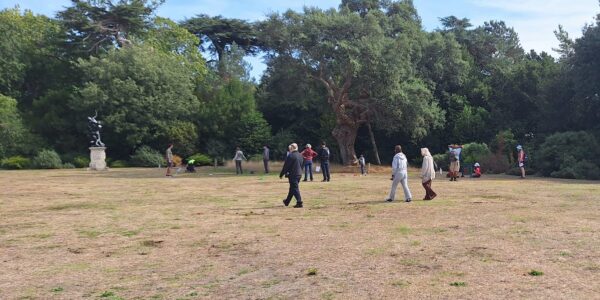
In the 1990s, efforts were made by talented sculptor Ivor Abrahams to recreate the piece for Painshill. He travelled to Florence, observing, photographing and sketching the statue in great detail. Back in England, he worked tirelessly to bring his creation to life. First creating a plaster sculpture, and eventually a bronze one that has stood on the original Portland stone foundation since 1993. The piece is not a replica (it stands at 2.6 m high compared to Giambologna’s 4.4 m) but rather an homage to the original; capturing the essence of its style, theme, and vision, and restoring the classical beauty to the Great Lawn.
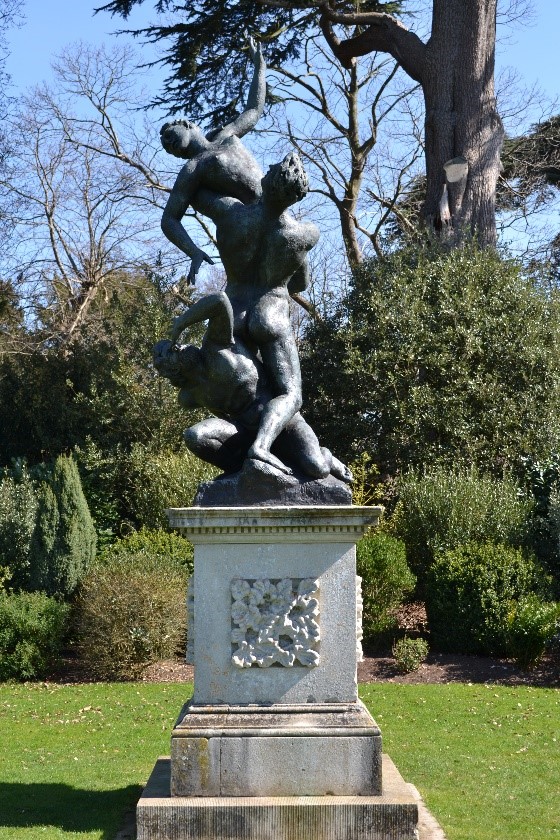
Painshill’s Great Lawn.
The Sabine statue tells a story of talent, myth, and mystery. It is an ode to the ancient world and the fortitude taken to bring Painshill back to life.
Long may it stand on its plinth, sharing the secrets of its past.
Acknowledgements
Cherrill Sands