THE ROMAN BATH
By Georgia Wilkinson
Narrated by Nicola Barranger
Painshill was no stranger to 18th century bathing trends. Dip into the history of our Roman Bath.
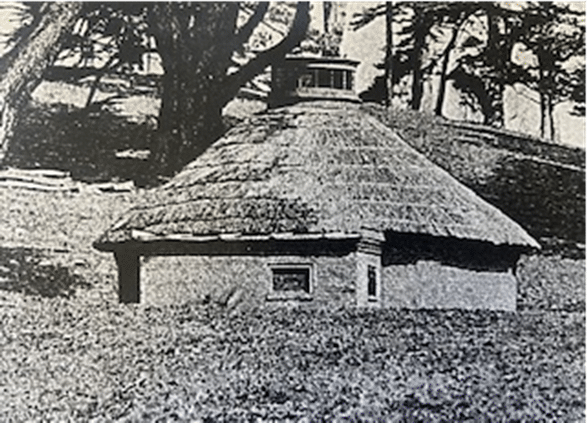
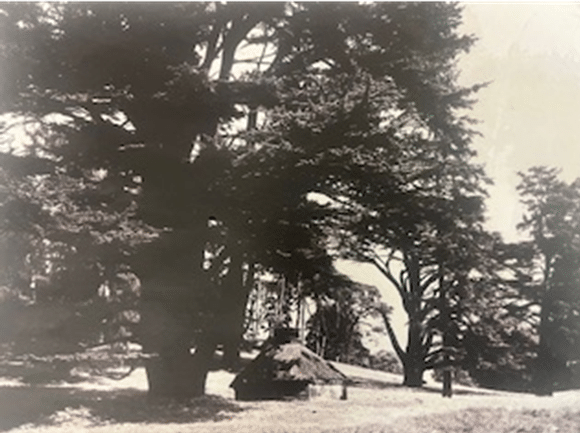
A close-up of the Roman Bath (external) in 1937.
It’s no secret that Charles Hamilton, the park’s founder, was inspired by his Grand Tours across Europe. The influence of his travels can be found throughout Painshill – from the Ruined Roman Arch to the Temple of Bacchus, the park exudes a beautiful, eccentric admiration for mythology and ancient architecture. This blend of 18th century history with the classical world is rooted in the park’s identity. And yet, on the northside of the lake, situated just below the Great Cedar Tree, is a well of brickwork buried beneath foliage and water. Nowadays, it is easy to mistake this structure for a pond, the eye drawn to the ducks paddling on the surface rather than the ruins beneath.
This is the Roman Bath. A fascinating piece of Painshill’s forgotten history.
After World War II, the park fell into ruin, materials were scavenged and repurposed for local uses, and nature engulfed Hamilton’s vision. When archaeologists began restoration works in the 1980s, they had to decide where to focus their efforts. Priority was given to the structures built between 1738 and 1773, the years of Hamilton’s ownership. The Roman Bath belongs to Painshill’s second chapter. The years in which it was owned by Benjamin Bond Hopkins, a wealthy gentleman who built himself a large house and continued the park’s development.
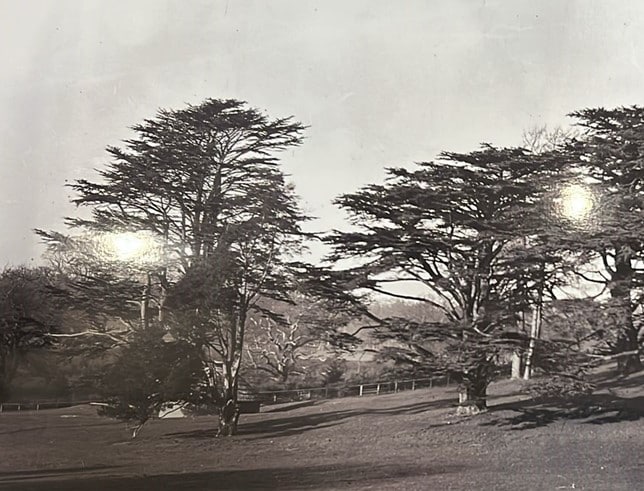
The earliest photograph of the Roman Bath in 1899.
In the 18th century, medicinal bathing was popularised and visits to spa towns like Bath or Buxton were fashionable. Between 1780 and 1790 Hopkins decided to build his own bathhouse inspired by Ancient Roman ones. It was made of brick with a thatch roof and a rather ‘unroman’ stained glass lantern allowing light inside. Hopkins would have entered via the north side of the building where he would have passed through a small antechamber that likely served as a changing room. The main room consisted of white tiled walls and flagstone flooring. Four depressions in the walls may have housed Roman-inspired statues and added to the classical ambience of the space. It was a circular room with a 3 ft 7 in internal pathway spanning the circumference while the bathing depression was 14 ft wide and 5 ft deep. Hopkins would have descended into the bath via a set of stairs, submerging himself in cold water supplied from a spring located to the North-West of the structure. Later, in the 1860s, a horse-powered engine was installed to pump water between the bath and the house that had previously belonged to Hopkins.
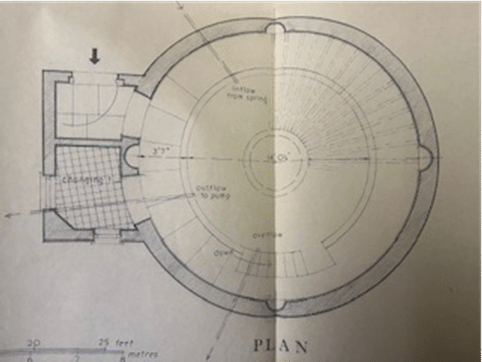
A floorplan showcasing the internal layout of the Roman Bath.
The exact date that the Roman Bath fell into ruin is unknown. It was last photographed in 1937 showing that the structure was still intact before the outbreak of World War II. An account from an employee, Joy Terry, who used to live on the site, suggests that the Roman Bath may have been in reasonably good condition as late as 1948. At which time, the walls were said to have been painted a decorative blue. After this, the ruin of the Bath slips into mystery. The thatch roof came down and the brickwork fell into disrepair. As this was not a part of Hamilton’s initial historic route it has never been restored to its original state.
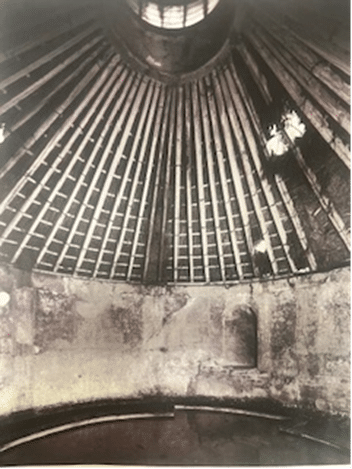
The interior of the Roman Bath pictured in 1937.
The brick depression still lies beneath the Great Cedar Tree waiting for its restoration. The Roman Bath represents a forgotten page in Painshill’s history – a charming relic of Grand Tours and 18th century fascination with the ancient world. A little patch of Rome right here in Surrey.
The Roman Bath pictured in 1937 beneath the Great Cedar Tree.